PIPA125530
GPR27 Polyclonal Antibody, Invitrogen™
Manufacturer: Thermo Scientific
Select a Size
| Pack Size | SKU | Availability | Price |
|---|---|---|---|
| Each of 1 | PIPA125530-Each-of-1 | In Stock | ₹ 46,591.50 |
PIPA125530 - Each of 1
In Stock
Quantity
1
Base Price: ₹ 46,591.50
GST (18%): ₹ 8,386.47
Total Price: ₹ 54,977.97
Antigen
GPR27
Classification
Polyclonal
Conjugate
Unconjugated
Gene
GPR27
Gene Alias
G protein-coupled receptor 27; GPR27; Probable G-protein coupled receptor 27; SREB1; Super conserved receptor expressed in brain 1
Host Species
Rabbit
Purification Method
Antigen affinity chromatography
Regulatory Status
RUO
Gene ID (Entrez)
2850
Content And Storage
Store at 4°C short term. For long term storage, store at -20°C, avoiding freeze/thaw cycles.
Form
Liquid
Applications
Immunocytochemistry, Immunohistochemistry (Paraffin)
Concentration
1 mg/mL
Formulation
PBS with 0.1% sodium azide
Gene Accession No.
Q9NS67
Gene Symbols
GPR27
Immunogen
Synthetic peptide corresponding to a region of human G Protein-Coupled Receptor GPR27.
Quantity
25 μg
Primary or Secondary
Primary
Target Species
Human
Product Type
Antibody
Isotype
IgG
Related Products
Description
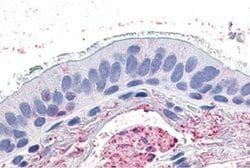
- PA1-25530 detects G Protein-Coupled Receptor GPR27 from human samples
- G protein coupled receptors (GPCRs) are a large family of receptors that have a similar structure characterized by 7 transmembrane domains
- Activation of GPCRs by extracellular stimuli such as neurotransmitters, hormones, or light induces an intracellular signaling cascade mediated by heterotrimeric GTP-binding proteins, or G proteins
- The 375 amino acid GPCR GPR27 protein contains several features of the GPCR family, including 7 transmembrane domains, potential N linked glycosylation sites in the N terminal extracellular domain, and conserved cysteine residues, which may form a disulfide bridge, in the first and second extracellular loops.