HDAC2 Polyclonal Antibody, Alexa Fluor™ 647, Invitrogen™
Manufacturer: Thermo Scientific
Select a Size
| Pack Size | SKU | Availability | Price |
|---|---|---|---|
| Each of 1 | PIPA1861AY-Each-of-1 | In Stock | ₹ 38,715.00 |
PIPA1861AY - Each of 1
In Stock
Quantity
1
Base Price: ₹ 38,715.00
GST (18%): ₹ 6,968.70
Total Price: ₹ 45,683.70
Antigen
HDAC2
Classification
Polyclonal
Conjugate
Alexa Fluor 647
Gene
HDAC2
Gene Alias
D10Wsu179e; HD2; hdac 2; Hdac2; hdac-2; Histone deacetylase 2; histone deacetylase 2-like protein; histone deacetylase-2; I79_010219; mRPD3; RPD3; transcriptional regulator homolog RPD3; YAF1; YY1 transcription factor-binding protein; YY1-associated factor 1; Yy1bp
Host Species
Rabbit
Purification Method
Antigen affinity chromatography
Regulatory Status
RUO
Gene ID (Entrez)
100764557, 15182, 3066, 475035, 84577
Content And Storage
4° C, store in dark, DO NOT FREEZE!
Form
Liquid
Applications
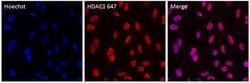
Immunocytochemistry
Concentration
1 mg/mL
Formulation
PBS with 1mg/mL BSA and 0.05% sodium azide; pH 7.4
Gene Accession No.
P70288, Q92769
Gene Symbols
HDAC2
Immunogen
Synthetic peptide corresponding to residues C T(475) D T K G T K S E Q L S N P(488) of human HDAC2
Quantity
50 μL
Primary or Secondary
Primary
Target Species
Canine, Hamster, Human, Mouse, Non-human Primate, Rat
Product Type
Antibody
Isotype
IgG
Related Products
Description
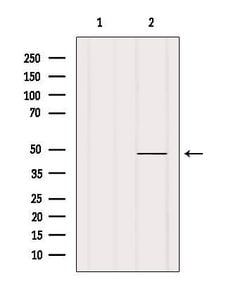
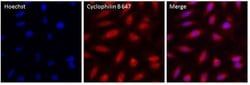
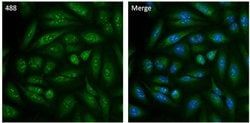
- PA1861A647 detects histone deacetylase 2 (HDAC2) from canine, hamster, human, mouse, non-human primate, rat tissues and cells
- The PA1861A647 immunogen is a synthetic peptide corresponding to residues C T(475) D T K G T K S E Q L S N P(488) of human HDAC2
- This immunizing peptide (Cat
- # PEP-070) is available for use in neutralization and control experiments
- HDAC2 belongs to the histone deacetylase family
- Histone deacetylases act via the formation of large multiprotein complexes and are responsible for the deacetylation of lysine residues at the N-terminal regions of core histones (H2A, H2B, H3 and H4)
- This protein forms transcriptional repressor complexes by associating with many different proteins, including YY1, a mammalian zinc-finger transcription factor
- Thus, it plays an important role in transcriptional regulation, cell cycle progression and developmental events
- Alternative splicing results in multiple transcript variants.