FGF9 Polyclonal Antibody, Invitrogen™
Manufacturer: Thermo Scientific
Select a Size
| Pack Size | SKU | Availability | Price |
|---|---|---|---|
| Each of 1 | PIPA5111618-Each-of-1 | In Stock | ₹ 48,905.50 |
PIPA5111618 - Each of 1
In Stock
Quantity
1
Base Price: ₹ 48,905.50
GST (18%): ₹ 8,802.99
Total Price: ₹ 57,708.49
Antigen
FGF9
Classification
Polyclonal
Conjugate
Unconjugated
Gene
FGF9
Gene Alias
Eks; elbow knee synostosis; FGF; Fgf9; FGF-9; Fibroblast growth factor; Fibroblast growth factor 9; fibroblast growth factor 9 (glia-activating factor); GAF; glia activating factor; glia-activating factor; HBFG-9; HBGF-9; Heparin-binding growth factor 9; M-FGF-9; SYNS3
Host Species
Rabbit
Purification Method
Antigen affinity chromatography
Regulatory Status
RUO
Gene ID (Entrez)
2254
Content And Storage
Store at 4°C short term. For long term storage, store at -20°C, avoiding freeze/thaw cycles.
Form
Liquid
Applications
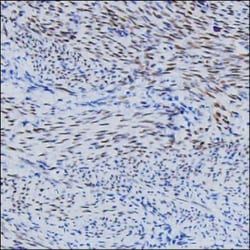
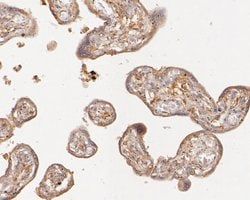
Immunohistochemistry
Concentration
0.2 mg/mL
Formulation
PBS with 40% glycerol and 0.02% sodium azide; pH 7.2
Gene Accession No.
P31371
Gene Symbols
FGF9
Immunogen
Recombinant Protein corresonding to Human FGF9
Quantity
100 μL
Primary or Secondary
Primary
Target Species
Human
Product Type
Antibody
Isotype
IgG
Related Products

Description
- Immunogen sequence: MAPLGEVGNY FGVQDAVPFG NVPVLPVDSP VLLSDHLGQS EAGGLPRGPA VTDLDHLKGI LR The protein encoded by this gene is a member of the fibroblast growth factor (FGF) family
- FGF family members possess broad mitogenic and cell survival activities, and are involved in a variety of biological processes, including embryonic development, cell growth, morphogenesis, tissue repair, tumor growth and invasion
- This protein was isolated as a secreted factor that exhibits a growth-stimulating effect on cultured glial cells
- In nervous system, this protein is produced mainly by neurons and may be important for glial cell development
- Expression of the mouse homolog of this gene was found to be dependent on Sonic hedgehog (Shh) signaling
- Mice lacking the homolog gene displayed a male-to-female sex reversal phenotype, which suggested a role in testicular embryogenesis.