STEP Polyclonal Antibody, Invitrogen™
Manufacturer: Thermo Scientific
Select a Size
| Pack Size | SKU | Availability | Price |
|---|---|---|---|
| Each of 1 | PIPA5111688-Each-of-1 | In Stock | ₹ 48,905.50 |
PIPA5111688 - Each of 1
In Stock
Quantity
1
Base Price: ₹ 48,905.50
GST (18%): ₹ 8,802.99
Total Price: ₹ 57,708.49
Antigen
STEP
Classification
Polyclonal
Formulation
PBS with 40% glycerol and 0.02% sodium azide; pH 7.2
Gene Accession No.
P54829
Gene Symbols
PTPN5
Immunogen
Recombinant Protein corresonding to Human STEP
Quantity
100 μL
Primary or Secondary
Primary
Target Species
Human
Product Type
Antibody
Isotype
IgG
Applications
Immunocytochemistry
Conjugate
Unconjugated
Gene
PTPN5
Gene Alias
FLJ14427; Neural-specific protein-tyrosine phosphatase; protein tyrosine phosphatase, non-receptor type 5; protein tyrosine phosphatase, non-receptor type 5 (striatum-enriched); protein-tyrosine phosphatase striatum-enriched; protein-tyrosine-phosphatase non-receptor 5; PTN5; PTP STEP; PTPN 5; PTPN5; PTPSTEP; STEP; STEP61; striatal-enriched protein tyrosine phosphatase; striatum-enriched protein-tyrosine phosphatase; Tyrosine-protein phosphatase non-receptor type 5
Host Species
Rabbit
Purification Method
Antigen affinity chromatography
Regulatory Status
RUO
Gene ID (Entrez)
84867
Content And Storage
Store at 4°C short term. For long term storage, store at -20°C, avoiding freeze/thaw cycles.
Form
Liquid
Related Products


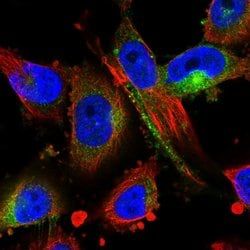
Description
- Immunogen sequence: EHTPIIVMIT NIEEMNEKCT EYWPEEQVAY DGVEITVQKV IHTEDYRLRL ISLKSGTEER GLKHY Reversible phosphorylation of tyrosine residues is a key regulatory mechanism for numerous cellular events such as proliferation, differentiation, gene expression and migration
- Abnormalities in tyrosine phosphorylation play a role in the pathogenesis of numerous inherited or acquired human diseases from cancer to immune deficiencies
- There are at least 107 genes coding for PTPs (protein tyrosine phosphatases) in the human genome
- All known PTPs contain a highly conserved 12 amino acid catalytic domain and are further distinguished on the basis of additional structural motifs
- The receptor-like PTPs exhibit an extracellular domain, a single transmembrane and one or two intracellular phosphatase domains
- The nonreceptor cytoplasmic PTPs contain a single phosphatase domain and additional amino acid sequences that are homologous to motifs found in other classes of proteins
- Protein tyrosine phosphatases PTPN5 (STEP), PTPRR and PTPN7 comprise a family of phosphatases that specifically inactivate MAPKs (mitogen-activated protein kinases)
- There are multiple forms of STEP in the adult rat brain which show differential enrichment in brain regions implicated in aspects of cognitive, affective, and motor behaviors
- Some of the STEP isoforms are generated through alternative splicing of a single STEP gene and each has unique intracellular targets and functions.