CD53 Polyclonal Antibody, Invitrogen™
Manufacturer: Thermo Scientific
Select a Size
| Pack Size | SKU | Availability | Price |
|---|---|---|---|
| Each of 1 | PIPA5114986-Each-of-1 | In Stock | ₹ 45,968.50 |
PIPA5114986 - Each of 1
In Stock
Quantity
1
Base Price: ₹ 45,968.50
GST (18%): ₹ 8,274.33
Total Price: ₹ 54,242.83
Antigen
CD53
Classification
Polyclonal
Conjugate
Unconjugated
Gene
Cd53
Gene Alias
AI323659; antigen MOX44 identified by monoclonal antibody MRC-OX44; Cd53; CD53 antigen; CD53 glycoprotein; CD53 molecule; CD53 tetraspan antigen; cell surface antigen; cell surface glycoprotein CD53; Leukocyte antigen MRC OX-44; leukocyte surface antigen CD53; MOX44; OX44; Ox-44; tetraspanin-25; transmembrane glycoprotein; TSPAN25; tspan-25
Host Species
Rabbit
Purification Method
Affinity chromatography
Regulatory Status
RUO
Gene ID (Entrez)
12508, 24251, 963
Content And Storage
-20°C
Form
Liquid
Applications
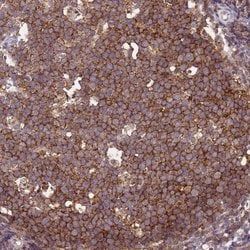
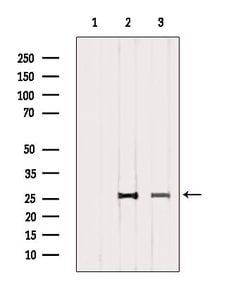
Immunocytochemistry, Western Blot
Concentration
1 mg/mL
Formulation
PBS with 50% glycerol and 0.02% sodium azide
Gene Accession No.
P19397, P24485, Q61451
Gene Symbols
Cd53
Immunogen
A synthesized peptide derived from human CD53(Accession P19397), corresponding to amino acid residues N46-E96.
Quantity
100 μL
Primary or Secondary
Primary
Target Species
Human, Mouse, Rat
Product Type
Antibody
Isotype
IgG
Related Products
Description
- Antibody detects endogenous levels of total CD53
- CD53 is a tetraspanin family transmembrane glycoprotein expressed in the lymphoid-myeloid lineage
- This molecule has been reported to form complexes with other leukocyte surface proteins such as CD2, CD19, CD21, MHC II, VLA-4 or tetraspanins CD37, CD81 and CD82, thus probably modulating various signaling processes
- CD53 is involved in radioresistancy of tumor cells and its triggering has anti-apoptotic effect
- In thymus, CD53 is up-regulated in response to positive selection signals during T cell development, and is strongly expressed upon macrophage exposure to bacterial lipopolysaccharide, whereas stimulation of neutrophils results in down-regulation of CD53 expression.