PSAP Polyclonal Antibody, Invitrogen™
Manufacturer: Thermo Scientific
Select a Size
| Pack Size | SKU | Availability | Price |
|---|---|---|---|
| Each of 1 | PIPA5121667-Each-of-1 | In Stock | ₹ 17,346.10 |
PIPA5121667 - Each of 1
In Stock
Quantity
1
Base Price: ₹ 17,346.10
GST (18%): ₹ 3,122.298
Total Price: ₹ 20,468.398
Antigen
PSAP
Classification
Polyclonal
Conjugate
Unconjugated
Gene
Psap
Gene Alias
A1 activator; AI037048; Cerebroside sulfate activator; Co-beta-glucosidase; Component C; CSAct; Dispersin; GLBA; Glucosylceramidase activator; Proactivator polypeptide; prosaposin; prosaposin (sulfated glycoprotein, sphingolipid hydrolase activator); Protein A; Protein C; Psap; SAP1; SAP-1; SAP-2; Saposin-A; Saposin-B; Saposin-B-Val; Saposin-C; Saposin-D; Sgp1; SGP-1; SGP1A; snoRNA MBII-198; Sphingolipid activator protein 1; Sphingolipid activator protein 2; sphingolipid activator protein-1; sulfated glycoprotein 1; Sulfatide/GM1 activator
Host Species
Rabbit
Purification Method
Antigen affinity chromatography
Regulatory Status
RUO
Gene ID (Entrez)
5660
Content And Storage
-20°C
Form
Liquid
Applications
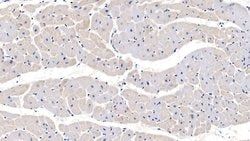
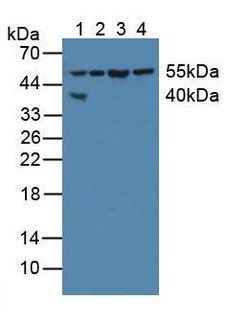
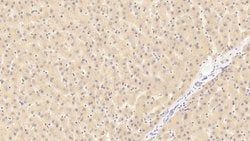
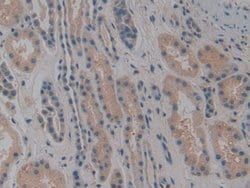
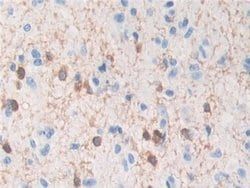
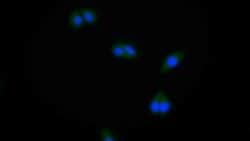
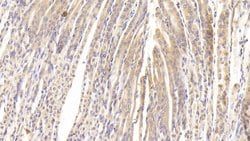
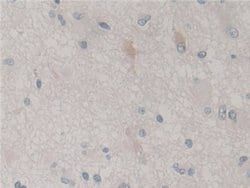
Immunocytochemistry, Immunohistochemistry (Paraffin), Western Blot
Concentration
0.94 mg/mL
Formulation
PBS with 50% glycerol and 0.05% ProClin 300
Gene Accession No.
P07602
Gene Symbols
Psap
Immunogen
Recombinant protein Prosaposin. The antigen corresponds to amino acid range 17-524 of the target protein.
Quantity
20 μL
Primary or Secondary
Primary
Target Species
Human
Product Type
Antibody
Isotype
IgG
Related Products
Description
- PSAP is a highly conserved glycoprotein which is a precursor for 4 cleavage products: saposins A, B, C, and D
- Each domain of the precursor protein is approximately 80 amino acid residues long with nearly identical placement of cysteine residues and glycosylation sites
- Saposins A-D localize primarily to the lysosomal compartment where they facilitate the catabolism of glycosphingolipids with short oligosaccharide groups
- The precursor protein exists both as a secretory protein and as an integral membrane protein and has neurotrophic activities.