NCDN Polyclonal Antibody, Invitrogen™
Manufacturer: Thermo Scientific
Select a Size
| Pack Size | SKU | Availability | Price |
|---|---|---|---|
| Each of 1 | PIPA5121745-Each-of-1 | In Stock | ₹ 19,669.00 |
PIPA5121745 - Each of 1
In Stock
Quantity
1
Base Price: ₹ 19,669.00
GST (18%): ₹ 3,540.42
Total Price: ₹ 23,209.42
Antigen
NCDN
Classification
Polyclonal
Conjugate
Unconjugated
Gene
NCDN
Gene Alias
AU042419; Kiaa0607; minisatellite 10ae detected by probe MMS10; mKIAA0607; MMS10-AE; Ms10ae; M-Sema F-associating protein of 75 kDa; NCDN; Neurite outgrowth-related protein from the rat brain; neurochondrin; neurochondrin-1; neurochondrin-2; Norbin; Sfap75; similar to neurochondrin
Host Species
Rabbit
Purification Method
Antigen affinity chromatography
Regulatory Status
RUO
Gene ID (Entrez)
89791
Content And Storage
-20°C
Form
Liquid
Applications
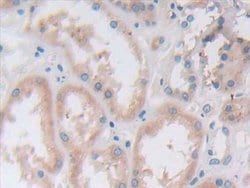
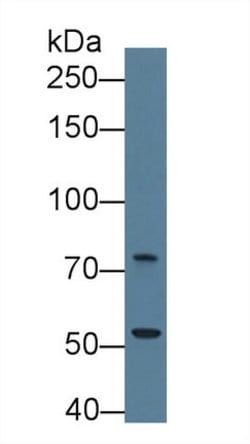
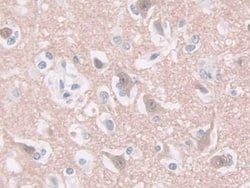
Immunocytochemistry, Immunohistochemistry (Paraffin), Western Blot
Concentration
500 μg/mL
Formulation
PBS with 50% glycerol and 0.05% ProClin 300
Gene Accession No.
O35095
Gene Symbols
NCDN
Immunogen
Recombinant protein Neurochondrin. The antigen corresponds to amino acid range 2-300 of the target protein.
Quantity
20 μL
Primary or Secondary
Primary
Target Species
Rat
Product Type
Antibody
Isotype
IgG
Related Products

Description
- Probably involved in signal transduction, in the nervous system, via increasing cell surface localization of GRM5 and positively regulating its signaling
- Required for the spatial learning process
- Acts as a negative regulator of Ca(2+)-calmodulin-dependent protein kinase 2 (CaMK2) phosphorylation
- May play a role in modulating melanin-concentrating hormone-mediated functions via its interaction with MCHR1 that interferes with G protein-coupled signal transduction
- May be involved in bone metabolism
- May also be involved in neurite outgrowth.