PIPA5143457
MERS Coronavirus Envelope Protein Polyclonal Antibody, Invitrogen™
Manufacturer: Thermo Scientific
Select a Size
| Pack Size | SKU | Availability | Price |
|---|---|---|---|
| Each of 1 | PIPA5143457-Each-of-1 | In Stock | ₹ 39,071.00 |
PIPA5143457 - Each of 1
In Stock
Quantity
1
Base Price: ₹ 39,071.00
GST (18%): ₹ 7,032.78
Total Price: ₹ 46,103.78
Antigen
MERS Coronavirus Envelope Protein
Classification
Polyclonal
Conjugate
Unconjugated
Gene Alias
Coronavirus; Envelope protein; MERS
Immunogen
Carrier-protein conjugated synthetic peptide encompassing a sequence within the C-terminus region of MERS-CoV Envelope protein. The exact sequence is proprietary.
Quantity
100 μL
Primary or Secondary
Primary
Content And Storage
Store at 4°C short term. For long term storage, store at -20°C, avoiding freeze/thaw cycles.
Form
Liquid
Applications
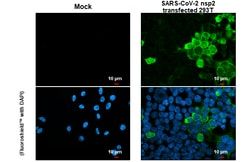
Immunocytochemistry, Western Blot
Concentration
1 mg/mL
Formulation
PBS with 20% glycerol and 0.025% Proclin 300; pH 7
Host Species
Rabbit
Purification Method
Antigen affinity chromatography
Regulatory Status
RUO
Target Species
Virus
Product Type
Antibody
Isotype
IgG
Related Products



Description
- Store as concentrated solution
- Centrifuge briefly prior to opening vial
- Middle East Respiratory Syndrome (MERS) is a contagious viral respiratory infection, whose origin was identified as the MERS-related coronavirus (MERS-CoV)|MERS-CoV is a single-stranded mRNA betacoronavirus|The MERS-CoV genome encodes four key structural proteins (spike, envelope, membrane, and nucleocapsid) that make up the virion particle|The MERS envelope protein (E) is the smallest of the structural proteins, and is abundantly expressed in the host cell during viral replication, despite only a fraction of synthesized E protein μgtimately being incorporated into new viral particles