SCNN1B Polyclonal Antibody, Invitrogen™
Manufacturer: Thermo Scientific
Select a Size
| Pack Size | SKU | Availability | Price |
|---|---|---|---|
| Each of 1 | PIPA528909-Each-of-1 | In Stock | ₹ 48,905.50 |
PIPA528909 - Each of 1
In Stock
Quantity
1
Base Price: ₹ 48,905.50
GST (18%): ₹ 8,802.99
Total Price: ₹ 57,708.49
Antigen
SCNN1B
Classification
Polyclonal
Conjugate
Unconjugated
Gene
SCNN1B
Gene Alias
Amiloride-sensitive sodium channel subunit beta; amiloride-sensitive sodium channel subunit beta 1; amiloride-sensitive sodium channel subunit beta-like protein; BESC1; Beta ENaC; beta-ENaC; Beta-NaCH; betaxENaC; ENaC beta; ENaCb; enacbeta; epithelial Na(+) channel subunit beta; epithelial sodium channel beta-2 subunit; epithelial sodium channel beta-3 subunit; epithelial sodium channel, nonvoltage-gated 1, beta; nasal epithelial sodium channel beta subunit; nonvoltage-gated sodium channel 1 subunit beta; RNENACB; SCNEB; SCNN 1B; SCNN1B; scnn1b.L; scnn1b-a; scnn1b-b; sodium channel epithelial 1 beta subunit; sodium channel, non voltage gated 1 beta subunit; sodium channel, non voltage gated 1 beta subunit L homeolog; sodium channel, nonvoltage-gated 1 beta; sodium channel, nonvoltage-gated 1, beta; sodium channel, non-voltage-gated 1, beta subunit; sodium channel, nonvoltage-gated, type I, beta; XELAEV_18045378mg
Host Species
Rabbit
Purification Method
Antigen affinity chromatography
Regulatory Status
RUO
Gene ID (Entrez)
6338
Content And Storage
Store at 4°C short term. For long term storage, store at -20°C, avoiding freeze/thaw cycles.
Form
Liquid
Applications
Western Blot
Concentration
1 mg/mL
Formulation
0.1M tris glycine with 10% glycerol and 0.01% thimerosal; pH 7
Gene Accession No.
P51168
Gene Symbols
SCNN1B
Immunogen
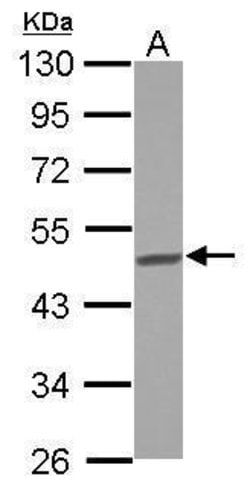
Recombinant fragment corresponding to a region within amino acids 119 and 332 of Human betaENaC
Quantity
100 μL
Primary or Secondary
Primary
Target Species
Human
Product Type
Antibody
Isotype
IgG
Related Products
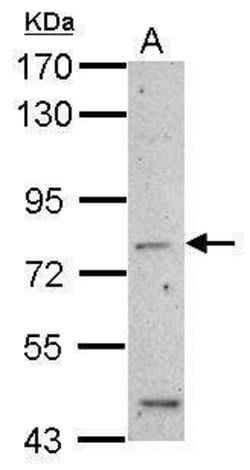
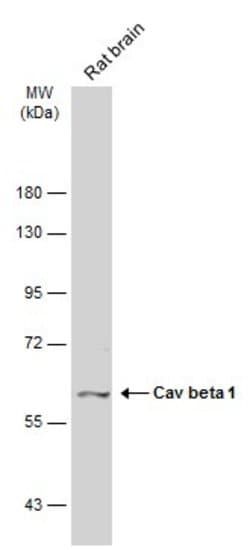
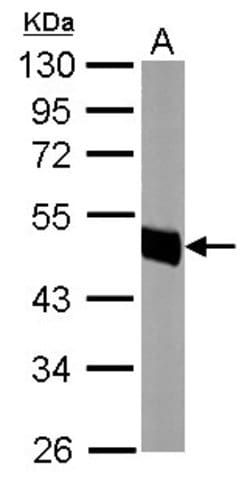
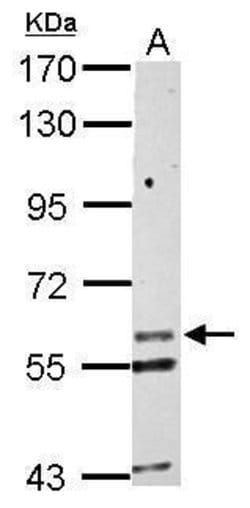
Description
- Recommended positive controls: 293T, A431, H1299, HeLa, HepG2, Molt-4, Raji
- Predicted reactivity: Dog (82%), Guinea pig (80%)
- Store product as a concentrated solution
- Centrifuge briefly prior to opening the vial
- Sodium permeable non-voltage-sensitive ion channel inhibited by the diuretic amiloride
- Mediates the electrodiffusion of the luminal sodium (and water, which follows osmotically) through the apical membrane of epithelial cells
- Controls the reabsorption of sodium in kidney, colon, lung and sweat glands
- Also plays a role in taste perception
- Heterotetramer of two alpha, one beta and one gamma subunit
- A delta subunit can replace the alpha subunit
- Interacts with the WW domains of NEDD4, NEDD4L, WWP1 and WWP2
- Defects in SCNN1B are a cause of autosomal recessive pseudohypoaldosteronism type 1 (PHA1) [MIM:264350]
- PHA1 is a rare salt wasting disease resulting from target organ unresponsiveness to mineralocorticoids
- There are 2 forms of PHA1: the autosomal recessive form that is severe, and the dominant form which is more milder and due to defects in mineralocorticoid receptor
- Autosomal recessive PHA1 is characterized by an often fulminant presentation in the neonatal period with dehydration, hyponatraemia, hyperkalaemia, metabolic acidosis, failure to thrive and weight loss
- Defects in SCNN1B are a cause of Liddle syndrome
- It is an autosomal dominant disorder characterized by pseudoaldosteronism and hypertension associated with hypokalemic alkalosis
- The disease is caused by constitutive activation of the renal epithelial sodium channel.