PFKFB1 Polyclonal Antibody, Invitrogen™
Manufacturer: Thermo Scientific
Select a Size
| Pack Size | SKU | Availability | Price |
|---|---|---|---|
| Each of 1 | PIPA529363-Each-of-1 | In Stock | ₹ 46,502.50 |
PIPA529363 - Each of 1
In Stock
Quantity
1
Base Price: ₹ 46,502.50
GST (18%): ₹ 8,370.45
Total Price: ₹ 54,872.95
Antigen
PFKFB1
Classification
Polyclonal
Conjugate
Unconjugated
Gene
PFKFB1
Gene Alias
6-biphosphatase 1; 6PF-2-K/Fru-2,6-P2ase 1; 6PF-2-K/Fru-2,6-P2ASE liver isozyme; 6-phosphofructo-2-kinase; 6-phosphofructo-2-kinase/fructose-2,6-biphosphatase 1; 6-phosphofructo-2-kinase/fructose-2,6-bisphosphatase 1; F6PK; Fructose-2,6-bisphosphatase; fructose-6-phosphate,2-kinase:fructose-2,6-bisphosphatase; HL2K; PFK/FBPase 1; PFK-2/FBPase-2 gene A; Pfkfb01; PFKFB1; PFRX
Host Species
Rabbit
Purification Method
Antigen affinity chromatography
Regulatory Status
RUO
Gene ID (Entrez)
5207
Content And Storage
Store at 4°C short term. For long term storage, store at -20°C, avoiding freeze/thaw cycles.
Form
Liquid
Applications
Immunocytochemistry, Immunohistochemistry (Paraffin), Western Blot
Concentration
0.67 mg/mL
Formulation
0.1M tris glycine with 10% glycerol and 0.01% thimerosal; pH 7
Gene Accession No.
P16118
Gene Symbols
PFKFB1
Immunogen
Recombinant fragment corresponding to a region within amino acids 1 and 194 of Human PFKFB1
Quantity
100 μL
Primary or Secondary
Primary
Target Species
Human
Product Type
Antibody
Isotype
IgG
Related Products



Description
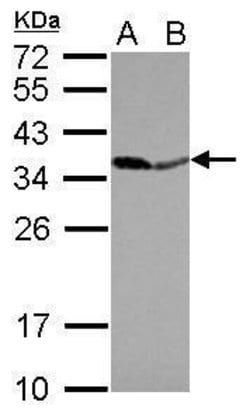
- Recommended positive controls: 293T, H1299, HeLa, Molt-4, Raji
- Predicted reactivity: Mouse (93%), Rat (94%), Pig (98%), Bovine (96%)
- Store product as a concentrated solution
- Centrifuge briefly prior to opening the vial
- Protein kinases are enzymes that transfer a phosphate group from a phosphate donor, generally the g phosphate of ATP, onto an acceptor amino acid in a substrate protein
- By this basic mechanism, protein kinases mediate most of the signal transduction in eukaryotic cells, regulating cellular metabolism, transcription, cell cycle progression, cytoskeletal rearrangement and cell movement, apoptosis, and differentiation
- With more than 500 gene products, the protein kinase family is one of the largest families of proteins in eukaryotes
- The family has been classified in 8 major groups based on sequence comparison of their tyrosine (PTK) or serine/threonine (STK) kinase catalytic domains
- The AGC kinase group consists of 63 kinases including the cyclic nucleotide-regulated protein kinase (PKA & PKG) family, the diacylglycerol-activated/phospholipid-dependent protein kinase C (PKC) family, the related to PKA and PKC (RAC/Akt) protein kinase family, the kinases that phosphorylate G protein-coupled receptors family (ARK), and the kinases that phosphorylate ribosomal protein S6 family (RSK).