LOXL2 Polyclonal Antibody, Invitrogen™
Manufacturer: Thermo Scientific
Select a Size
| Pack Size | SKU | Availability | Price |
|---|---|---|---|
| Each of 1 | PIPA532900-Each-of-1 | In Stock | ₹ 46,591.50 |
PIPA532900 - Each of 1
In Stock
Quantity
1
Base Price: ₹ 46,591.50
GST (18%): ₹ 8,386.47
Total Price: ₹ 54,977.97
Antigen
LOXL2
Classification
Polyclonal
Conjugate
Unconjugated
Gene
LOXL2
Gene Alias
1110004B06Rik; 4930526G11Rik; 9430067E15Rik; LOR2; Loxl2; Lysyl oxidase homolog 2; lysyl oxidase homolog 2; LOW QUALITY PROTEIN: lysyl oxidase homolog 2; lysyl oxidase like 2; lysyl oxidase related 2; lysyl oxidase-like 2; lysyl oxidase-like 2 delta e13; lysyl oxidase-like 2 protein; lysyl oxidase-like protein 2; Lysyl oxidase-related protein 2; lysyl oxidase-related protein WS9-14; WS9-14
Host Species
Rabbit
Purification Method
Antigen affinity chromatography
Regulatory Status
RUO
Gene ID (Entrez)
4017
Content And Storage
Store at 4°C short term. For long term storage, store at -20°C, avoiding freeze/thaw cycles.
Form
Liquid
Applications
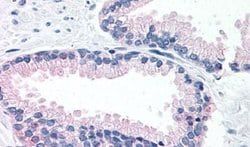
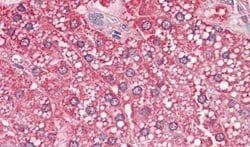
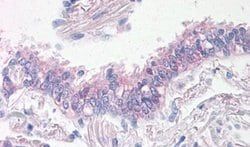
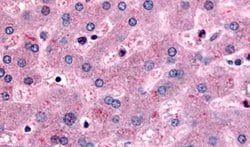
Immunohistochemistry (Paraffin)
Concentration
1 mg/mL
Formulation
PBS with 0.1% sodium azide
Gene Accession No.
Q9Y4K0
Gene Symbols
LOXL2
Immunogen
Synthetic 17 amino acid peptide from internal region of human LOXL2.
Quantity
50 μg
Primary or Secondary
Primary
Target Species
Human
Product Type
Antibody
Isotype
IgG
Related Products
Description
- Percent identity with other species by BLAST analysis: Human, Marmoset (100%) Gorilla, Orangutan, Monkey, Bovine, Bat, Elephant (94%) Dog, Panda, Horse, Opossum (88%)
- This gene encodes a member of the lysyl oxidase gene family
- The prototypic member of the family is essential to the biogenesis of connective tissue, encoding an extracellular copper-dependent amine oxidase that catalyses the first step in the formation of crosslinks in collagens and elastin
- A highly conserved amino acid sequence at the C-terminus end appears to be sufficient for amine oxidase activity, suggesting that each family member may retain this function
- The N-terminus is poorly conserved and may impart additional roles in developmental regulation, senescence, tumor suppression, cell growth control, and chemotaxis to each member of the family.