MAS1 Polyclonal Antibody, Invitrogen™
Manufacturer: Thermo Scientific
Select a Size
| Pack Size | SKU | Availability | Price |
|---|---|---|---|
| Each of 1 | PIPA533919-Each-of-1 | In Stock | ₹ 46,502.50 |
PIPA533919 - Each of 1
In Stock
Quantity
1
Base Price: ₹ 46,502.50
GST (18%): ₹ 8,370.45
Total Price: ₹ 54,872.95
Antigen
MAS1
Classification
Polyclonal
Conjugate
Unconjugated
Gene
MAS1
Gene Alias
angiotensin-(1-7) receptor; c-mas; MAS; MAS proto-oncogene; MAS1; Mas-1; MAS1 oncogene; Mas1 proto-oncogene; MAS1 proto-oncogene, G protein-coupled receptor; Mas-related G protein-coupled receptor a; MGC119966; MGRA; Proto-oncogene Mas
Host Species
Rabbit
Purification Method
Antigen affinity chromatography
Regulatory Status
RUO
Gene ID (Entrez)
4142
Content And Storage
Store at 4°C short term. For long term storage, store at -20°C, avoiding freeze/thaw cycles.
Form
Liquid
Applications
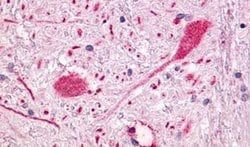
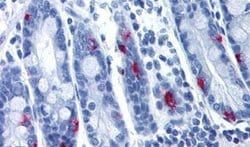
Immunohistochemistry (Paraffin)
Concentration
1 mg/mL
Formulation
PBS with 0.1% sodium azide
Gene Accession No.
P04201
Gene Symbols
MAS1
Immunogen
Synthetic 17 amino acid peptide from 2nd extracellular domain of human MAS1.
Quantity
50 μg
Primary or Secondary
Primary
Target Species
Human
Product Type
Antibody
Isotype
IgG
Related Products
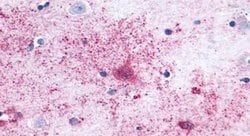

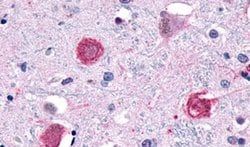
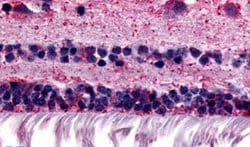
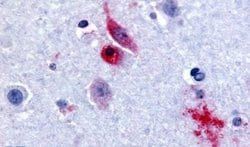
Description
- Percent identity with other species by BLAST analysis: Human (100%) Gorilla, Monkey (94%) Mouse (82%)
- The structure of the MAS1 product indicates that it belongs to the class of receptors that are coupled to GTP-binding proteins and share a conserved structural motif, which is described as a 7-transmembrane segment following the prediction that these hydrophobic segments form membrane-spanning alpha-helices
- The MAS1 protein may be a receptor that, when activated, modulates a critical component in a growth-regulating pathway to bring about oncogenic effects.