PIPA534154
RGR Polyclonal Antibody, Invitrogen™
Manufacturer: Thermo Scientific
Select a Size
| Pack Size | SKU | Availability | Price |
|---|---|---|---|
| Each of 1 | PIPA534154-Each-of-1 | In Stock | ₹ 47,392.50 |
PIPA534154 - Each of 1
In Stock
Quantity
1
Base Price: ₹ 47,392.50
GST (18%): ₹ 8,530.65
Total Price: ₹ 55,923.15
Antigen
RGR
Classification
Polyclonal
Conjugate
Unconjugated
Gene
RGR
Gene Alias
retinal G protein coupled receptor; Rgr; RGR opsin; RGR-opsin; RP44; RPE retinal G-protein coupled receptor; RPE-retinal G protein-coupled receptor
Host Species
Rabbit
Purification Method
Antigen affinity chromatography
Regulatory Status
RUO
Gene ID (Entrez)
5995
Content And Storage
Store at 4°C short term. For long term storage, store at -20°C, avoiding freeze/thaw cycles.
Form
Liquid
Applications
Immunohistochemistry (Paraffin)
Concentration
1 mg/mL
Formulation
PBS with 0.1% sodium azide
Gene Accession No.
P47804
Gene Symbols
RGR
Immunogen
Synthetic 16 amino acid peptide from 1st extracellular domain of human RGR.
Quantity
50 μg
Primary or Secondary
Primary
Target Species
Human, Non-human Primate
Product Type
Antibody
Isotype
IgG
Related Products

Description
- Percent identity with other species by BLAST analysis: Human, Gibbon, Monkey, Marmoset (100%) Bovine, Horse, Pig (94%) Dog, Bat, Elephant (88%) Mouse, Rat, Hamster (81%)
- This gene encodes a putative retinal G-protein coupled receptor
- The gene is a member of the opsin subfamily of the 7 transmembrane, G-protein coupled receptor 1 family
- Like other opsins which bind retinaldehyde, it contains a conserved lysine residue in the seventh transmembrane domain
- The protein acts as a photoisomerase to catalyze the conversion of all-trans-retinal to 11-cis-retinal
- The reverse isomerization occurs with rhodopsin in retinal photoreceptor cells
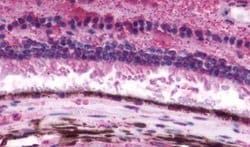
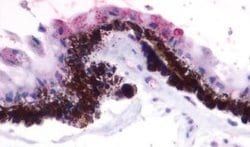
- The protein is exclusively expressed in tissue adjacent to retinal photoreceptor cells, the retinal pigment epithelium and Mueller cells
- This gene may be associated with autosomal recessive and autosomal dominant retinitis pigmentosa (arRP and adRP, respectively)
- Alternative splicing results in multiple transcript variants encoding different isoforms.