PIPA532848
GPR149 Polyclonal Antibody, Invitrogen™
Manufacturer: Thermo Scientific
Select a Size
| Pack Size | SKU | Availability | Price |
|---|---|---|---|
| Each of 1 | PIPA532848-Each-of-1 | In Stock | ₹ 46,502.50 |
PIPA532848 - Each of 1
In Stock
Quantity
1
Base Price: ₹ 46,502.50
GST (18%): ₹ 8,370.45
Total Price: ₹ 54,872.95
Antigen
GPR149
Classification
Polyclonal
Conjugate
Unconjugated
Gene
GPR149
Gene Alias
G protein-coupled receptor 149; G protein-coupled receptor PGR10; GPR149; G-protein coupled receptor PGR10; IEDA; PGR10; Probable G-protein coupled receptor 149
Host Species
Rabbit
Purification Method
Antigen affinity chromatography
Regulatory Status
RUO
Gene ID (Entrez)
344758
Content And Storage
Store at 4°C short term. For long term storage, store at -20°C, avoiding freeze/thaw cycles.
Form
Liquid
Applications
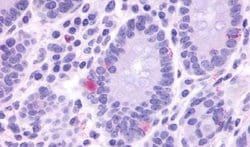
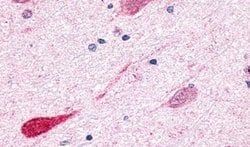
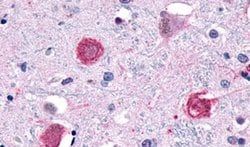
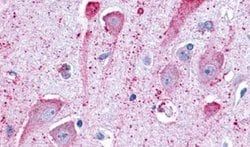
Immunohistochemistry (Paraffin)
Concentration
1 mg/mL
Formulation
PBS with 0.1% sodium azide
Gene Accession No.
Q86SP6
Gene Symbols
GPR149
Immunogen
Synthetic 16 amino acid peptide from C-terminus of human GPR149.
Quantity
50 μg
Primary or Secondary
Primary
Target Species
Human, Non-human Primate
Product Type
Antibody
Isotype
IgG
Related Products
Description
- Percent identity with other species by BLAST analysis: Human, Gorilla, Gibbon, Marmoset (100%); Bovine, Dog, Elephant, Pig (94%); Bat, Panda, Rabbit, Horse (88%)
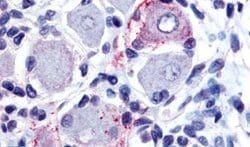
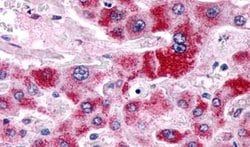
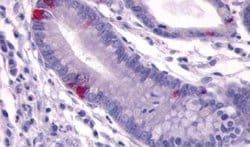
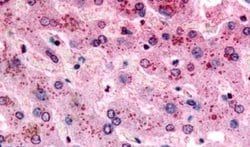
- For IHC(P), use heat induced antigen retrieval in pH 6.0 citrate buffer
- After incubation with the primary antibody, slides were incubated with biotinylated secondary antibody, followed by alkaline phosphatase-streptavidin and chromogen
- This gene encodes a seven-transmembrane G protein coupled receptor (GPCR) class A family member
- Although categorized as a class A GPCR, the encoded protein lacks the first two charged amino acids of the highly conserved Asp-Arg-Tyr (DRY) motif found in the third transmembrane helix of class A receptors which is important for efficient G protein-coupled signal transduction
- Mice with a knockout of the orthologous gene are viable and have normal maturation of the ovarian follicle, but show enhanced fertility and ovulation
- All GPCRs have a common structural architecture consisting of seven transmembrane alpha-helices interconnected by three extracellular and three intracellular loops
- A general feature of GPCR signaling is agonist-induced conformational changes in the receptor, leading to activation of the heterotrimeric G proteins, which consist of the guanine nucleotide-binding G-alpha subunit and the dimeric G-beta-gamma subunits
- The activated G proteins then bind to and activate numerous downstream effector proteins, which generate second messengers that mediate a broad range of cellular and physiological processes.