BTG1 Polyclonal Antibody, Invitrogen™
Manufacturer: Thermo Scientific
Select a Size
| Pack Size | SKU | Availability | Price |
|---|---|---|---|
| Each of 1 | PIPA578372-Each-of-1 | In Stock | ₹ 48,905.50 |
PIPA578372 - Each of 1
In Stock
Quantity
1
Base Price: ₹ 48,905.50
GST (18%): ₹ 8,802.99
Total Price: ₹ 57,708.49
Antigen
BTG1
Classification
Polyclonal
Conjugate
Unconjugated
Gene
BTG1
Gene Alias
AI426953; anti-proliferative factor; APRO2; AW546738; B cell translocation gene 1, anti-proliferative; B-cell translocation gene 1 protein; B-cell translocation gene 1, anti-proliferative; BTG anti-proliferation factor 1; Btg1; Protein BTG1
Host Species
Rabbit
Purification Method
Antigen affinity chromatography
Regulatory Status
RUO
Gene ID (Entrez)
12226, 694
Content And Storage
Store at 4°C short term. For long term storage, store at -20°C, avoiding freeze/thaw cycles.
Form
Liquid
Applications
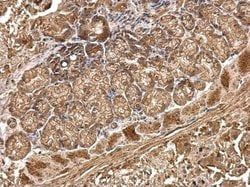
Immunohistochemistry (Paraffin)
Concentration
1 mg/mL
Formulation
PBS with 20% glycerol and 0.01% thimerosal; pH 7
Gene Accession No.
P62324, P62325
Gene Symbols
BTG1
Immunogen
Recombinant protein encompassing a sequence within the center region of human BTG1. The exact sequence is proprietary.
Quantity
100 μL
Primary or Secondary
Primary
Target Species
Human, Mouse
Product Type
Antibody
Isotype
IgG
Related Products

Description
- Predicted Reactivity: Human (100%), Rat (99%), Pig (100%), Chicken (93%), Sheep (100%), Rhesus Monkey (100%), Bovine (100%) Store product as a concentrated solution
- Centrifuge briefly prior to opening the vial
- BTG1 is a member of an anti-proliferative gene family that regulates cell growth and differentiation
- Expression of this gene is highest in the G0/G1 phases of the cell cycle and downregulated when cells progressed through G1
- The encoded protein interacts with several nuclear receptors, and functions as a coactivator of cell differentiation
- This locus has been shown to be involved in a t(8; 12)(q24; q22) chromosomal translocation in a case of B-cell chronic lymphocytic leukemia.