CPSF4L Polyclonal Antibody, Invitrogen™
Manufacturer: Thermo Scientific
Select a Size
| Pack Size | SKU | Availability | Price |
|---|---|---|---|
| Each of 1 | PIPA595821-Each-of-1 | In Stock | ₹ 46,502.50 |
PIPA595821 - Each of 1
In Stock
Quantity
1
Base Price: ₹ 46,502.50
GST (18%): ₹ 8,370.45
Total Price: ₹ 54,872.95
Antigen
CPSF4L
Classification
Polyclonal
Conjugate
Unconjugated
Gene
Cpsf4l
Gene Symbols
Cpsf4l
Immunogen
Recombinant fusion protein containing a sequence corresponding to amino acids 1-228 of mouse Cpsf4l (NP_0809582)
Quantity
100 μL
Primary or Secondary
Primary
Target Species
Mouse
Product Type
Antibody
Isotype
IgG
Applications
Western Blot
Concentration
1.63 mg/mL
Formulation
PBS with 50% glycerol and 0.01% thimerosal, pH 7.3
Gene Alias
0610010C04Rik, 1500000C01Rik, cleavage and polyadenylation specific factor 4 like, cleavage and polyadenylation specific factor 4-like, Cpsf4l, D11Ertd636e, putative cleavage and polyadenylation specificity factor subunit 4-like protein, RGD1306397
Host Species
Rabbit
Purification Method
Affinity Chromatography
Regulatory Status
RUO
Gene ID (Entrez)
52670
Content And Storage
-20° C, Avoid Freeze/Thaw Cycles
Form
Liquid
Related Products
Description
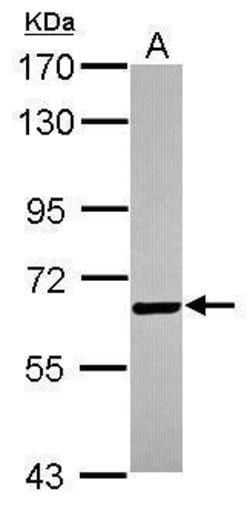
- Immunogen sequence: MEEVIAGLQG FTFAFELDVE SQKGTGLLPF QGMDKSSSAV CNFFAKGLCV KGMLCPLRHE QGEKLVVCKH WLRGLCRKSD CCDFLHQYDV SKMPVCYFHS KFGNCSNKEC LFLHLKPVLK LQDCPWYNQG FCKEVGPLCK YRHVHQVLCP NYFTGFCPEG PQCQFGHPKM SPPFHPSNVK LQPVNQPWDS TTSTGNTLVS PFQAKPMVHG QRRWSLPQAC SSRAHPAP; Positive Samples: Mouse testis, Mouse brain CRTAC1 encodes a glycosylated extracellular matrix protein that is found in the interterritorial matrix of articular deep zone cartilage
- This protein is used as a marker to distinguish chondrocytes from osteoblasts and mesenchymal stem cells in culture
- The presence of FG-GAP motifs and an RGD integrin-binding motif suggests that this protein may be involved in cell-cell or cell-matrix interactions
- Copy number alterations in this gene have been observed in neurofibromatosis type 1-associated glomus tumors
- Alternative splicing results in multiple transcript variants.