47-201-282
CD201 (EPCR) Monoclonal Antibody (eBio1560 (1560)), APC-eFluor™ 780, eBioscience™, Invitrogen™
Manufacturer: Invitrogen
Select a Size
| Pack Size | SKU | Availability | Price |
|---|---|---|---|
| Each of 1 | 47-201-282-Each-of-1 | In Stock | ₹ 34,621.00 |
47-201-282 - Each of 1
In Stock
Quantity
1
Base Price: ₹ 34,621.00
GST (18%): ₹ 6,231.78
Total Price: ₹ 40,852.78
Antigen
CD201 (EPCR)
Classification
Monoclonal
Concentration
0.2 mg/mL
Formulation
PBS with 0.09% sodium azide, pH 7.2
Gene Accession No.
Q64695
Gene Symbols
Procr
Purification Method
Affinity chromatography
Regulatory Status
RUO
Gene ID (Entrez)
19124
Content And Storage
4° C, store in dark, DO NOT FREEZE!
Form
Liquid
Applications
Flow Cytometry
Clone
eBio1560 (1560)
Conjugate
APC-eFluor 780
Gene
Procr
Gene Alias
Activated protein C receptor, AI325044, APC receptor, bA42O4.2, CCCA, CCD41, CD antigen CD201, CD201, CD201 antigen, cell cycle, centrosome-associated protein, centrocyclin, Centrosomal protein CCD41, endothelial cell protein C receptor, Endothelial protein C receptor, Epcr, PROCR, protein C receptor, protein C receptor, endothelial
Host Species
Rat
Quantity
100 μg
Primary or Secondary
Primary
Target Species
Mouse
Product Type
Antibody
Isotype
IgG2b κ
Related Products


Description
- Description: The eBio1560 monoclonal antibody reacts with mouse Endothelial Protein C Receptor (EPCR, CD201), a 25 kDa Type 1 transmembrane protein expressed on endothelial cells
- EPCR exhibits sequence and structural homology with the MHC class I/CD1 family of proteins
- EPCR is a ligand for Protein C and plays an important role in augmenting Protein C activation by the thrombin-thrombomodulin complex and in regulating blood coagulation and inflammation
- Deletion of EPCR results in embryonic lethality, at least partically due to placental thrombosis
- Recently, it was demonstrated that EPCR expression identified cells in the bone marrow that are capable of hematopoietic reconstitution activity comparable to hematopoietic stem cells isolated with conventional methods
- The eBio1560 monoclonal antibody can be used for the detection of these hematopoietic stem cells, however the eBiomRCR-16 monoclonal antibody should only be used for the detection of CD201 on endothelial cells
- Applications Reported: This eBio1560 antibody has been reported for use in flow cytometric analysis
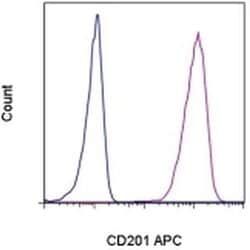
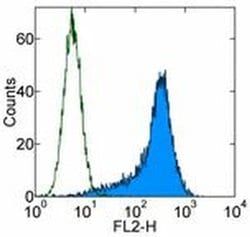
- Applications Tested: This eBio1560 antibody has been tested by flow cytometric analysis of bEnd.3 cells
- This may be used at less than or equal to 0.5 μg per test
- A test is defined as the amount (μg) of antibody that will stain a cell sample in a final volume of 100 μL
- Cell number should be determined empirically but can range from 10^5 to 10^8 cells/test
- The protein encoded by this gene is a receptor for activated protein C, a serine protease activated by and involved in the blood coagulation pathway
- The encoded protein is an N-glycosylated type I membrane protein that enhances the activation of protein C
- Mutations in this gene have been associated with venous thromboembolism and myocardial infarction, as well as with late fetal loss during pregnancy.