50-108-50
NOTCH3 Monoclonal Antibody (HMN3-133), PE, eBioscience™, Invitrogen™
Manufacturer: Invitrogen
Select a Size
| Pack Size | SKU | Availability | Price |
|---|---|---|---|
| Each | 50-108-50-Each | In Stock | ₹ 7,889.85 |
50-108-50 - Each
In Stock
Quantity
1
Base Price: ₹ 7,889.85
GST (18%): ₹ 1,420.173
Total Price: ₹ 9,310.023
Antigen
NOTCH3
Classification
Monoclonal
Concentration
0.2 mg/mL
Formulation
PBS with 0.09% sodium azide; pH 7.2
Gene Accession No.
Q61982
Gene Symbols
Notch3
Purification Method
Affinity chromatography
Regulatory Status
RUO
Gene ID (Entrez)
18131
Content And Storage
4° C, store in dark, DO NOT FREEZE!
Form
Liquid
Applications
Flow Cytometry
Clone
HMN3-133
Conjugate
PE
Gene
Notch3
Gene Alias
AW229011; CADASIL; CADASIL1; CASIL; hpbk; IMF2; LMNS; N3; Neurogenic locus notch homolog protein 3; notch 3; Notch 3 extracellular truncation; Notch 3 intracellular domain; Notch gene homolog 3; Notch homolog 3; NOTCH3
Host Species
Armenian Hamster
Quantity
25 μg
Primary or Secondary
Primary
Target Species
Mouse
Product Type
Antibody
Isotype
IgG
Related Products
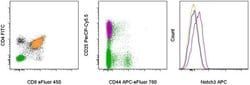
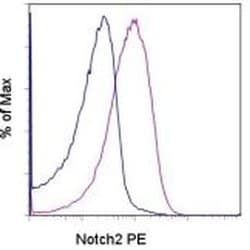


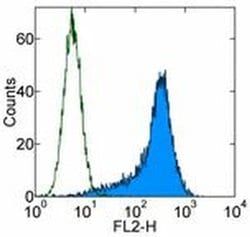

Description
- Description: This HMN3-133 monoclonal antibody reacts with mouse Notch3, one of four members of the Notch family of receptors
- Notch receptors are 300-kDa single-pass transmembrane proteins
- While the extracellular domain contains numerous epidermal growth factor-like repeats for ligand binding, the intracellular domain is involved in cell signaling
- Upon binding its membrane-bound ligand (either Delta or Jagged), the Notch receptor undergoes proteolytic cleavage, first by ADAM-family metalloproteases and then by gamma-secretase
- The second cleavage event releases the Notch intracellular domain (NICD), which subsequently translocates into the nucleus, heterodimerizes with the DNA-binding protein RBP-J, recruits co-activator molecules, and ultimately activates transcription
- Notch 3 expression has been demonstrated on regulatory T cells and some thymocyte subsets, including CD4-CD8- and CD8SP cells
- In addition, this Notch receptor is prevalent in vascular smooth muscle and the central nervous system
- In addition to its role in stem cell hematopoiesis, Notch 3 plays a pivotal role in mammalian T cell lineage commitment and thymocyte development
- Specifically, Notch 3 has been implicated in the CD4-CD8- double negative (DN) to CD4+CD8+ double positive transition with greatest expression in DN3 (CD4-CD8-CD25+CD44-) cells
- Notch 3 may also be involved in regulating the pre-TCR checkpoint via crosstalk with the NFkappaB and E2A signaling pathways
- NOTCH3 is the third discovered human homologue of the Drosophilia melanogaster type I membrane protein notch
- In Drosophilia, notch interaction (with its cell-bound ligands delta, serrate) establishes an intercellular signalling pathway that plays a key role in neural development
- Homologues of the notch-ligands have also been identified in human
- NOTCH3 functions as a receptor for membrane-bound ligands Jagged1, Jagged2, and Delta1 to regulate cell-fate determination
- Mutations in NOTCH3 have been identified as the underlying cause of cerebral autosomal dominant arteriopathy with subcortical infarcts and leukoencephalopathy (CADASIL).