50-112-2876
Blood Group Antigen H (O) Type 1 Monoclonal Antibody (17-206), eBioscience™, Invitrogen™
Manufacturer: Invitrogen
Select a Size
| Pack Size | SKU | Availability | Price |
|---|---|---|---|
| Each of 1 | 50-112-2876-Each-of-1 | In Stock | ₹ 32,040.00 |
50-112-2876 - Each of 1
In Stock
Quantity
1
Base Price: ₹ 32,040.00
GST (18%): ₹ 5,767.20
Total Price: ₹ 37,807.20
Antigen
Blood Group Antigen H (O) Type 1
Classification
Monoclonal
Concentration
0.5 mg/mL
Formulation
PBS with 0.09% sodium azide; pH 7.2
Host Species
Mouse
Quantity
100 μg
Primary or Secondary
Primary
Content And Storage
4° C
Form
Liquid
Applications
ELISA, Immunohistochemistry (Paraffin)
Clone
17-206
Conjugate
Unconjugated
Gene Alias
ABH; BG-H; BG-H1; group h
Purification Method
Affinity chromatography
Regulatory Status
RUO
Target Species
Human
Product Type
Antibody
Isotype
IgG3
Related Products
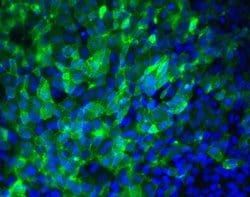


Description
- Description: The monoclonal antibody 17-206 recognizes the human blood group antigen H (O) type 1, a subtype primarily found in epithelial and secretory cells
- The precursor H antigen is modified by addition of saccharides to carbohydrate chains of proteins and lipids on erythrocytes and epithelial cells
- The type, attachment, location, and sequence of saccharides determines the blood group antigen subtype and is mediated by multiple glycosyl transferases
- Depending on ABO blood type, the H antigen is converted into either the A antigen, B antigen, both the A and B antigen, or left unconverted (O antigen)
- Evidence that the blood group antigen H is not expressed in tumor cells and that the level correlates with disease progression suggests that the blood group antigen H may be involved in cell proliferation, cell adhesion, and angiogenesis, although its exact function remains to be determined
- The 17-206 antibody does not recognize blood group antigen H (O) type 2
- Applications Reported: This 17-206 antibody has been reported for use in immunohistochemical staining of formalin-fixed paraffin embedded tissue sections and ELISA
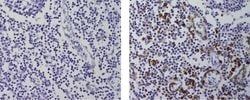
- Applications Tested: This 17-206 antibody has been tested by immunohistochemistry on formalin-fixed paraffin embedded human tissue using either high or low pH antigen retrieval at less than or equal to 5 μg/mL
- It is recommended that the antibody be carefully titrated for optimal performance in the assay of interest
- The H antigen is a precursor to the ABO blood group antigens, present in people of all common blood types
- The Bombay phenotype (hh) does not express antigen H on red blood cells, and therefore this type will also lack A or B antigens, similar to the O blood group
- However, unlike O group, the H antigen is absent, hence the individuals produce isoantibodies to antigen H as well as to both A and B antigens
- If they receive blood from someone with O blood group, the anti-H antibodies will bind to the H antigen on the red blood cells of the donor blood and destroy the RBCs by complement-mediated lysis
- Therefore, people with Bombay phenotype can receive blood only from other hh donors, although they can donate as though they were type O
- Some individuals with the blood group A1 may also be able to produce anti-H antibodies due to the complete conversion of all the H antigen to A1 antigen
- Production of the H antigen, or its deficiency in the Bombay phenotype, is controlled at the H locus on chromosome 19
- The H locus contains three exons that span more than 5 kb of genomic DNA, and encodes the fucosyltransferase that produces the H antigen on RBCs
- The H antigen is a carbohydrate sequence with carbohydrates linked mainly to protein (with a minor fraction attached to ceramide moiety).