CD171 Monoclonal Antibody (eBio5G3 (5G3)), Biotin, eBioscience™, Invitrogen™
Mouse Monoclonal Antibody
Manufacturer: Fischer Scientific
The price for this product is unavailable. Please request a quote
Antigen
CD171
Concentration
0.5 mg/mL
Classification
Monoclonal
Form
Liquid
Regulatory Status
RUO
Formulation
PBS with 0.09% sodium azide; pH 7.2
Gene Alias
antigen identified by monoclonal antibody R1; CAML1; CD 171; CD171; CD171 molecule; HSAS; HSAS1; Hyd; L1; L1 cell adhesion molecule; L1CAM; MASA; MIC5; N-CAM L1; NCAML1; N-CAML1; N-CAM-L1; NCAM-L1; Nerve-growth factor-inducible large external glycoprotein; neural cell adhesion molecule L1; NILE; S10; sCD171; sL1 CAM; sL1CAM; soluble CD 171; soluble CD171; soluble L1 CAM; soluble L1CAM; SPG1
Gene Symbols
L1CAM
Primary or Secondary
Primary
Content And Storage
4° C, store in dark, DO NOT FREEZE!
Gene
L1CAM
Clone
eBio5G3 (5G3)
Applications
Flow Cytometry, Immunohistochemistry (Frozen), Western Blot
Conjugate
Biotin
Host Species
Mouse
Target Species
Human
Gene Accession No.
P32004
Gene ID (Entrez)
3897
Isotype
IgG2a
Purification Method
Affinity chromatography
Product Type
Antibody
Related Products


Description
- Description: The monoclonal antibody eBio5G3 recognizes CD171 also known as neural cell adhesion molecule L1
- CD171 is a member of the Ig superfamily containing 6 extracellular Ig domains and five fibronectin type III-like repeats
- CD171 has been shown to function as a cell adhesion molecule mediating homotypic and heterotypic cell-cell interactions in neuronal myelination, neurite outgrowth and regeneration
- Expression of CD171 has been found on monocytes and mature monocytic-derived and follicular DCs, a minor subset of lymphocytes in addition to that found on neuronal tissue and some tumor cells lines
- Expression of CD171 on tumors is thought to contribute to tumor progression
- Epitope of eBio5G3 is in amino-terminal Ig-like domain
- Applications Reported: This eBio5G3 (5G3) antibody has been reported for use in flow cytometric analysis, immunoblotting (WB), and immunohistology staining of frozen tissue sections
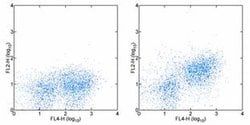
- Applications Tested: This eBio5G3 (5G3) antibody has been tested by flow cytometric analysis of Panc-1 cell line
- This can be used at less than or equal to 0.5 μg per test
- A test is defined as the amount (μg) of antibody that will stain a cell sample in a final volume of 100 μL
- Cell number should be determined empirically but can range from 10^5 to 10^8 cells/test
- It is recommended that the antibody be carefully titrated for optimal performance in the assay of interest
- Filtration: 0.2 μm post-manufacturing filtered
- L1CAM/CD171 is an axonal glycoprotein belonging to the immunoglobulin supergene family
- The ectodomain, consisting of several immunoglobulin-like domains and fibronectin-like repeats (type III), is linked via a single transmembrane sequence to a conserved cytoplasmic domain
- This cell adhesion molecule plays an important role in nervous system development, including neuronal migration and differentiation
- Mutations in the gene cause three X-linked neurological syndromes known by the acronym CRASH (corpus callosum hypoplasia, retardation, aphasia, spastic paraplegia and hydrocephalus)
- Alternative splicing of a neuron-specific exon is thought to be functionally relevant.