7092309
IDO Monoclonal Antibody (eyedio), eFluor™ 660, eBioscience™, Invitrogen™
Mouse Monoclonal Antibody
Manufacturer: Fischer Scientific
The price for this product is unavailable. Please request a quote
Antigen
IDO
Concentration
5 μL/Test
Classification
Monoclonal
Form
Liquid
Regulatory Status
RUO
Formulation
PBS with 0.2% BSA and 0.09% sodium azide; pH 7.2
Gene Alias
EC 1.13.11.52; IDO; IDO1; IDO-1; INDO; indolamine 2,3 dioxygenase; indole 2,3-dioxygenase; indoleamine; indoleamine 2,3-dioxygenase 1; indoleamine 23-dioxygenase; Indoleamine-2; indoleamine-pyrrole 2,3 dioxygenase; indoleamine-pyrrole 2,3-dioxygenase
Gene Symbols
Ido1
Primary or Secondary
Primary
Content And Storage
4° C, store in dark, DO NOT FREEZE!
Gene
Ido1
Clone
eyedio
Applications
Flow Cytometry
Conjugate
eFluor 660
Host Species
Mouse
Target Species
Human
Gene Accession No.
P14902
Gene ID (Entrez)
3620
Isotype
IgG1 κ
Purification Method
Affinity chromatography
Product Type
Antibody
Related Products


Description
- Description: This eyedio monoclonal antibody reacts with human indoleamine-2,3-dioxygenase (IDO, INDO, IDO1), an intracellular enzyme that catalyzes the degradation of tryptophan to kynurenines
- IDO is expressed in a wide variety of tissues and cells, including macrophages, plasmacytoid dendritic cells, and several cell lines
- IDO can be induced in many different cell types by IFN gamma or other inflammatory stimuli
- Expression of IDO in antigen presenting cells and tumors is thought to mediate immune suppression through depletion of this essential amino acid and/or by the creation of tryptophan metabolites that cause apoptosis of T cells and induction of regulatory T cells
- Applications Reported: This eyedio antibody has been reported for use in intracellular staining followed by flow cytometric analysis
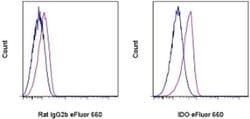
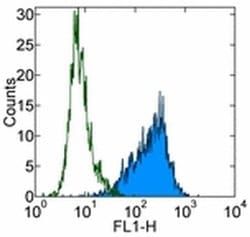
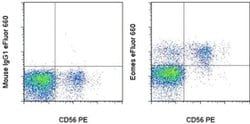
- Applications Tested: This eyedio antibody has been pre-titrated and tested by intracellular staining and flow cytometric analysis of stimulated normal human peripheral blood cells using the Intracellular Fixation & Permeabilization Buffer Set (cat
- 88-8824) and protocol
- Please refer to Best Protocols: Protocol A: Two step protocol for (cytoplasmic) intracellular proteins located under the Resources Tab online
- This antibody can be used at 5 μL (0.06 μg) per test
- A test is defined as the amount (μg) of antibody that will stain a cell sample in a final volume of 100 μL
- IDO1 is an intracellular heme-containing enzyme that catalyzes the oxidative cleavage of the indole ring of several important regulatory molecules like tryptophan, serotonin, and melatonin
- By doing this, IDO1 initiates the production of biologically active metabolites, commonly referred to as kynurenines
- IDO1 is widely expressed in a variety of human tissues as well as in macrophages and dendritic cells (DCs)
- In inflammation, interferons (IFNs) act on specific receptors to trigger IDO1 induction
- The production of IFN-gamma and induction of IDO1 represent important antimicrobial mechanisms
- Degradation and depletion of tryptophan by IDO1 inhibits the growth of viruses, bacteria and parasites
- Furthermore, IDO1 plays a complex and crucial role in immunoregulation during infection, pregnancy, autoimmunity, transplantation, and neoplasia.