7092308
IDO Monoclonal Antibody (mIDO-48), eFluor™ 660, eBioscience™, Invitrogen™
Rat Monoclonal Antibody
Manufacturer: Fischer Scientific
The price for this product is unavailable. Please request a quote
Antigen
IDO
Concentration
0.2 mg/mL
Classification
Monoclonal
Form
Liquid
Regulatory Status
RUO
Formulation
PBS with 0.09% sodium azide; pH 7.2
Gene Alias
EC 1.13.11.52; IDO; IDO1; IDO-1; INDO; indolamine 2,3 dioxygenase; indole 2,3-dioxygenase; indoleamine; indoleamine 2,3-dioxygenase 1; indoleamine 23-dioxygenase; Indoleamine-2; indoleamine-pyrrole 2,3 dioxygenase; indoleamine-pyrrole 2,3-dioxygenase
Gene Symbols
Ido1
Primary or Secondary
Primary
Content And Storage
4° C, store in dark, DO NOT FREEZE!
Gene
Ido1
Clone
mIDO-48
Applications
Flow Cytometry, Immunocytochemistry, Immunohistochemistry (Paraffin), Western Blot
Conjugate
eFluor 660
Host Species
Rat
Target Species
Mouse
Gene Accession No.
P28776
Gene ID (Entrez)
15930
Isotype
IgG2b κ
Purification Method
Affinity chromatography
Product Type
Antibody
Related Products



Description
- Description: The monoclonal antibody mIDO-48 reacts with mouse indoleamine 2,3-dioxygenase 1(IDO1)
- IDO1 is an enzyme expressed intracellularly by dendritic cells, interferon gamma activated macrophages, epithelial cells, vascular endothelium and tumor cells
- This enzyme catalyzes tryptophan into kynurenine metabolites
- The reduction of tryptophan and the introduction of kynurenine metabolites in the microenvironment of IDO-expressing cells suppress T cell proliferation and promote the activation and induction of regulatory T cells
- Applications Reported: This mIDO-48 antibody has been reported for use in intracellular staining followed by flow cytometric analysis
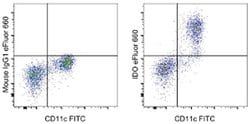
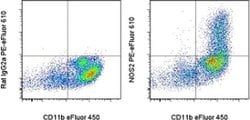
- Applications Tested: This mIDO-48 antibody has been tested by intracellular staining and flow cytometric analysis of mouse splenocytes using the Intracellular Fixation & Permeabilization Buffer Set (cat
- 88-8824) and protocol
- Please refer to Best Protocols: Protocol A: Two step protocol for (cytoplasmic) intracellular proteins located under the Resources Tab online
- This can be used at less than or equal to 1 μg per test
- A test is defined as the amount (μg) of antibody that will stain a cell sample in a final volume of 100 μL
- Cell number should be determined empirically but can range from 10^5 to 10^8 cells/test
- It is recommended that the antibody be carefully titrated for optimal performance in the assay of interest
- IDO1 is an intracellular heme-containing enzyme that catalyzes the oxidative cleavage of the indole ring of several important regulatory molecules like tryptophan, serotonin, and melatonin
- By doing this, IDO1 initiates the production of biologically active metabolites, commonly referred to as kynurenines
- IDO1 is widely expressed in a variety of human tissues as well as in macrophages and dendritic cells (DCs)
- In inflammation, interferons (IFNs) act on specific receptors to trigger IDO1 induction
- The production of IFN-gamma and induction of IDO1 represent important antimicrobial mechanisms
- Degradation and depletion of tryptophan by IDO1 inhibits the growth of viruses, bacteria and parasites
- Furthermore, IDO1 plays a complex and crucial role in immunoregulation during infection, pregnancy, autoimmunity, transplantation, and neoplasia.