7143944
CD86 Recombinant Rabbit Monoclonal Antibody (BLR029F), Bethyl Laboratories
Rabbit Recombit Monoclonal Antibody
Manufacturer: Fischer Scientific
The price for this product is unavailable. Please request a quote
Antigen
CD86
Applications
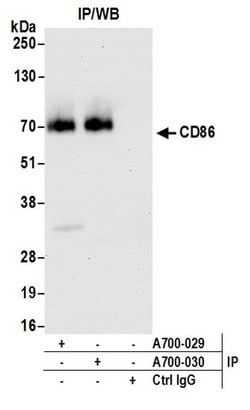
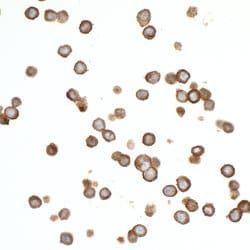
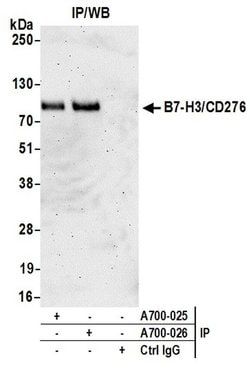
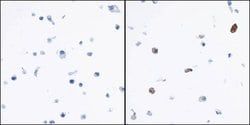
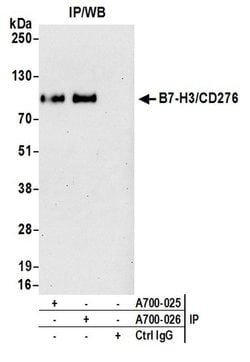
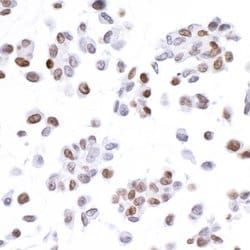
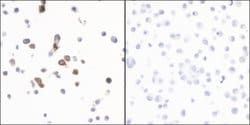
Immunocytochemistry, Immunoprecipitation, Western Blot
Conjugate
Unconjugated
Host Species
Rabbit
Target Species
Human
Gene Accession No.
P42081
Gene ID (Entrez)
942
Immunogen
recombit protein representing the extracellular domain
Primary or Secondary
Primary
Content And Storage
4° C
Gene
CD86
Clone
BLR029F
Classification
Recombinant Monoclonal
Form
Liquid
Regulatory Status
RUO
Formulation
BBS with 0.09% sodium azide; pH 8.2
Gene Alias
B7-2, B7.2, B70, CD28LG2, LAB72, MGC34413, B-lymphocyte activation antigen B7-2, B-lymphocyte antigen B7-2, B7-2 antigen, BU63, CD28 antigen ligand 2
Gene Symbols
CD86
Isotype
IgG
Purification Method
Antigen affinity chromatography
Product Type
Antibody
Related Products
Description
- The recommended shelf life for this product is 1 year from date of receipt
- Application Note: For ICC, epitope retrieval with citrate buffer pH 6.0 is recommended for FFPE cell sections
- CD86 is one of two ligands (the other CD80) for CTLA4 and CD28
- CD86 acts as costimulatory molecule in eliciting T-cell help during antigen presentation
- Antigen presentation in the absence of sufficient co-stimulation involving CD86/CD80 can induce tolerance
- CD80 appears to play a role distinct from CD80 in T helper cell differentiation
- CD86 is a type I membrane protein that is a member of the immunoglobulin superfamily
- The CD86 protein is expressed by antigen-presenting cells, and it is the ligand for two proteins at the cell surface of T cells, CD28 antigen and cytotoxic T-lymphocyte-associated protein 4
- Binding of CD86 with CD28 antigen is a costimulatory signal for activation of the T-cell
- Binding of CD86 with cytotoxic T-lymphocyte-associated protein 4 negatively regulates T-cell activation and diminishes the immune response
- Alternative splicing results in two transcript variants encoding different isoforms of CD86
- Additional transcript variants have been described for CD86, but their full-length sequences have not been determined
- Diseases associated with CD86 dysfunction include gallbladder squamous cell carcinoma and myocarditis.