7188756
HDAC1 Monoclonal Antibody (10E2), Active Motif™
Mouse Monoclonal Antibody
Manufacturer: Fischer Scientific
The price for this product is unavailable. Please request a quote
Antigen
HDAC1
Concentration
1 mg/mL
Classification
Monoclonal
Form
Liquid
Regulatory Status
RUO
Formulation
antibody with 30% glycerol and 0.035% sodium azide; pH
Gene Alias
DKFZp686H12203; GON-10; HD1; HDAC1; Hdac1-ps; Histone deacetylase 1; histone deacetylase 1-like protein; MommeD5; reduced potassium dependency, yeast homolog-like 1; RP4-811H24.2; RPD3; RPD3L1
Gene Symbols
HDAC1
Isotype
IgG1
Content And Storage
-20°C, Avoid Freeze/Thaw Cycles
Gene
HDAC1
Clone
10E2
Applications
Immunocytochemistry, Immunofluorescence, Western Blot
Conjugate
Unconjugated
Host Species
Mouse
Target Species
Human, Mouse, Rat
Gene Accession No.
O09106, Q13547, Q4QQW4
Gene ID (Entrez)
297893, 3065, 433759
Immunogen
This HDAC1 antibody was raised against a kLH-conjugated peptide corresponding to amino acids 467-482 of human and murine HDAC1.
Primary or Secondary
Primary
Product Type
Antibody
Related Products
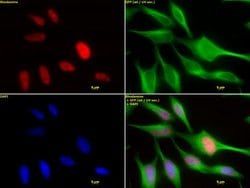



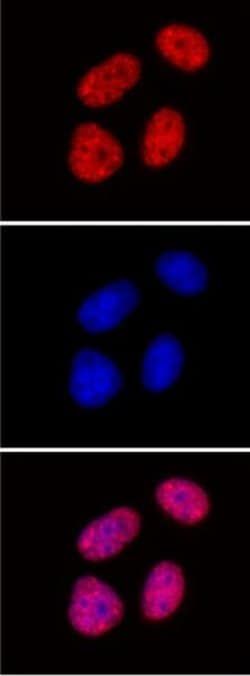

Description
- Description Histone deacetylase (HDAC) is responsible for the deacetylation of lysine residues on the N-terminal part of the core histones - H2A, H2B, H3, and H4
- Histone deacetylation gives a tag for epigenetic repression and plays and important role in transcriptional regulation, cell cycle progression, and developmental events
- Histone deacetylases act via the formation of large multiprotein complexes.