BIK (phospho T33) Rabbit anti-Human, Polyclonal , Abnova™
Manufacturer: Abnova Corporation
Select a Size
| Pack Size | SKU | Availability | Price |
|---|---|---|---|
| Each of 1 | 89-956-739-Each-of-1 | In Stock | ₹ 55,803.00 |
89-956-739 - Each of 1
In Stock
Quantity
1
Base Price: ₹ 55,803.00
GST (18%): ₹ 10,044.54
Total Price: ₹ 65,847.54
Antigen
BIK (phospho T33)
Classification
Polyclonal
Description
Rabbit polyclonal antibody raised against synthetic phosphopeptide of human BIK.
Formulation
In PBS (without Mg2+and Ca2+), 150 mM NaCl, pH 7.4 (50% glycerol, 0.02% sodium azide)
Gene Symbols
BIK
Immunogen
Synthetic phosphopeptide (conjugated with KLH) corresponding to residues surrounding T33 of human BIK.
Quantity
100 μL
Primary or Secondary
Primary
Test Specificity
BIK (phospho T33) polyclonal antibody detects endogenous levels of human BIK only when phosphorylated at threonine 33.
Content And Storage
Store at -20°C.Aliquot to avoid repeated freezing and thawing.
Applications
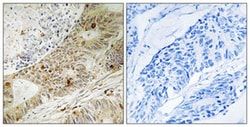
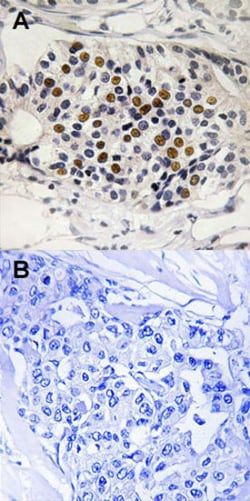
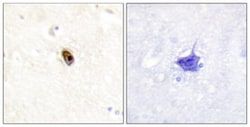
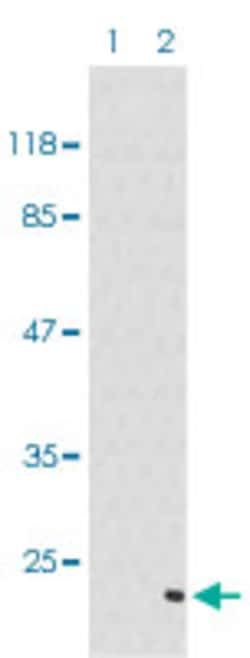
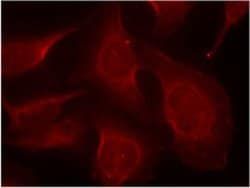
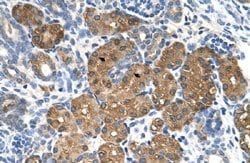
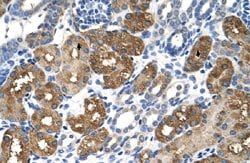
Immunohistochemistry (PFA fixed), Western Blot
Conjugate
Unconjugated
Dilution
Immunohistochemistry (1:50-1:100) Western Blot (1:500-1:3000) The optimal working dilution should be determined by the end user.
Gene Alias
BIP1/BP4/NBK
Host Species
Rabbit
Purification Method
Affinity chromatography
Regulatory Status
RUO
Gene ID (Entrez)
638
Target Species
Human
Form
Liquid
Related Products
Description
- The protein encoded by this gene is known to interact with cellular and viral survival-promoting proteins, such as BCL2 and the Epstein-Barr virus in order to enhance programed cell death
- Because its activity is suppressed in the presence of survival-promoting proteins, this protein is suggested as a likely target for antiapoptotic proteins
- This protein shares a critical BH3 domain with other death-promoting proteins, BAX and BAK
- [provided by RefSeq]