MA12021
Acetylated Lysine Monoclonal Antibody (1C6), Invitrogen™
Manufacturer: Thermo Scientific
Select a Size
| Pack Size | SKU | Availability | Price |
|---|---|---|---|
| Each of 1 | MA12021-Each-of-1 | In Stock | ₹ 50,018.00 |
MA12021 - Each of 1
In Stock
Quantity
1
Base Price: ₹ 50,018.00
GST (18%): ₹ 9,003.24
Total Price: ₹ 59,021.24
Antigen
Acetylated Lysine
Classification
Monoclonal
Concentration
1 mg/mL
Formulation
PBS with 1mg/mL BSA and 0.05% sodium azide
Host Species
Mouse
Purification Method
Protein G
Regulatory Status
RUO
Target Species
Chemical
Product Type
Antibody
Isotype
IgG2b
Applications
ChIP Assay, Dot Blot, Immunocytochemistry, Immunoprecipitation, Peptide Array, Western Blot
Clone
1C6
Conjugate
Unconjugated
Gene Alias
Acetyl Lysine; Acetylated Lysine; Acetyllysine
Immunogen
Synthetic peptide sequence surrounding the acetylated lysine 9 of histone H3.
Quantity
100 μg
Primary or Secondary
Primary
Content And Storage
-20° C, Avoid Freeze/Thaw Cycles
Form
Liquid
Target Molecule
Chemical
Related Products



Description
- MA1-2021 detects human and mouse, and monkey acetylated lysine
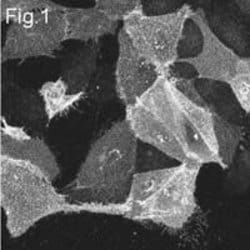
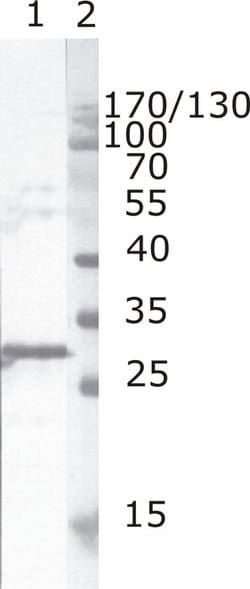
- MA1-2021 has been used successfully in Western blot, immunoprecipitation, dot blot, ChIP Assay, and immunofluorescence (cells) procedures
- By Western blot, this antibody may detect a ladder of acetylated proteins in HeLa cell lysate
- In immunofluorescence procedures, MA1-2021 recognizes acetylated lysine in gamma irradiated HeLa cells
- The MA1-2021 immunogen is a synthetic peptide sequence surrounding the acetylated lysine 9 of histone H3
- In the nucleus, DNA is tightly packed into nucleosomes generating an environment which is highly repressive towards DNA processes such as transcription
- Acetylation of lysine residues within proteins has emerged as an important mechanism used by cells to overcome this repression
- The acetylation of non-histone proteins such as transcription factors, as well as histones appears to be involved in this process
- Acetylation may result in structural transitions as well as specific signaling within discrete chromatin domains
- The role of acetylation in intracellular signaling has been inferred from the binding of acetylated peptides by the conserved bromodomain
- Furthermore, recent findings suggest that bromodomain/acetylated-lysine recognition can serve as a regulatory mechanism in protein-protein interactions in numerous cellular processes such as chromatin remodeling and transcriptional activation.