MilliporeSigma™ EGFR, Mouse, Unlabeled, Clone: 7F12.1,
Manufacturer: MilliporeSigma™
Select a Size
| Pack Size | SKU | Availability | Price |
|---|---|---|---|
| Each of 1 | MABS835MI-Each-of-1 | In Stock | ₹ 38,958.86 |
MABS835MI - Each of 1
In Stock
Quantity
1
Base Price: ₹ 38,958.86
GST (18%): ₹ 7,012.595
Total Price: ₹ 45,971.455
Antigen
EGFR
Classification
Monoclonal
Concentration
Please refer to lot specific datasheet.
Formulation
Purified mouse IgG2bκ in buffer containing 0.1M Tris-Glycine (pH 7.4), 150mM NaCl with 0.05% Sodium Azide.
Gene Accession No.
P00533
Immunogen
GST-tagged recombinant human EGFR fragment correspoding to a cytoplasmic region C-terminal to the kinase domain.
Regulatory Status
RUO
Primary or Secondary
Primary
Test Specificity
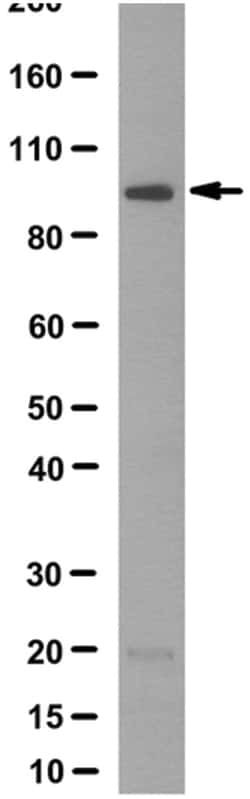
Epitope region is present in spliced isoform 1 (p170), but not in isoform 2 (p60, Truncated, TEGFR), isoform 3 (p110) or isoform 4 reported by UniProt (P00533).
Content And Storage
Stable for 1 year at 2°-8°C from date of receipt.
Isotype
IgG2b κ
Applications
Immunocytochemistry, Western Blot
Clone
7F12.1
Conjugate
Unconjugated
Gene
EGFR, ERBB, ERBB1, HER1, NISBD2
Host Species
Mouse
Quantity
50 μg
Research Discipline
Signaling
Gene ID (Entrez)
NP_005219
Target Species
Human
Form
Purified
Related Products



Description
- Epidermal growth factor receptor (EC 2.7.10.1; UniProt P00533; also known as Proto-oncogene c-ErbB-1, Receptor tyrosine-protein kinase erbB-1) is encoded by the EGFR (also known as ERBB, ERBB1, HER1, NISBD2) gene (Gene ID 1956) in human
- The epidermal growth factor receptor (EGFR; Proto-oncogene c-ErbB-1) is a ubiquitously receptor tyrosine kinase that is activated by a variety of ligands
- Upon ligand-bound EGFR undergoes dimerization and autophosphorylation exposing cytoplasmic domains, which allows its interaction with adaptor proteins and induction of several signaling pathways including PI3K-AKT; PLC-gamma-PKC; Notch1; and Ras-Raf
- Hence, it contributes to a diverse range of cellular processes, including cell proliferation
- Several studies have reported that EGFR signaling plays an important role in the development of various tumors
- EGFR is regulated by PTPRJ and PTPRK phosphatases, and by the endocytic machinery including EPS15 that mediates internalization and degradation of the receptor.