APEX2 Polyclonal Antibody, Invitrogen™
Manufacturer: Thermo Scientific
Select a Size
| Pack Size | SKU | Availability | Price |
|---|---|---|---|
| Each of 1 | PA129809-Each-of-1 | In Stock | ₹ 53,400.00 |
PA129809 - Each of 1
In Stock
Quantity
1
Base Price: ₹ 53,400.00
GST (18%): ₹ 9,612.00
Total Price: ₹ 63,012.00
Antigen
APEX2
Classification
Polyclonal
Conjugate
Unconjugated
Gene
APEX2
Gene Alias
AP endonuclease 2; AP endonuclease XTH2; Ape2; APEX nuclease (apurinic/apyrimidinic endonuclease) 2; APEX nuclease 2; APEX nuclease-like 2; APEX2; APEXL2; apurinic/apyrimidinic endodeoxyribonuclease 2; apurinic/apyrimidinic endonuclease 2; apurinic/apyrimidinic endonuclease-like 2; Apurinic-apyrimidinic endonuclease 2; C430040P13Rik; DNA-(apurinic or apyrimidinic site) lyase 2; RP5-884M20.3; XTH2; ZGRF2; zinc finger, GRF-type containing 2
Host Species
Rabbit
Purification Method
Protein G
Regulatory Status
RUO
Gene ID (Entrez)
27301
Content And Storage
Store at 4°C short term. For long term storage, store at -20°C, avoiding freeze/thaw cycles.
Form
Liquid
Applications
Western Blot
Concentration
0.5 mg/mL
Formulation
PBS with 0.05% BSA and 0.02% sodium azide
Gene Accession No.
Q9UBZ4
Gene Symbols
APEX2
Immunogen
This antibody was generated by immunizing rabbits with EELRALDSEGRALLTQHKI (aa122-140) and GQAKTSEAKDEKELRTSF (aa438-455) peptides of human APEX2
Quantity
200 μL
Primary or Secondary
Primary
Target Species
Human
Product Type
Antibody
Isotype
IgG
Related Products






Description
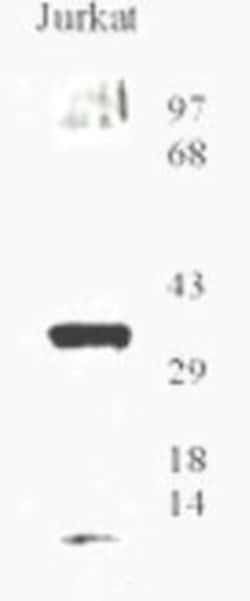
- PA1-29809 detects APEX2 from human samples
- Apurinic/apyrimidinic (AP) sites occur frequently in DNA molecules by spontaneous hydrolysis, by DNA damaging agents or by DNA glycosylases that remove specific abnormal bases
- AP sites are pre-mutagenic lesions that can prevent normal DNA replication so the cell contains systems to identify and repair such sites
- Class II AP endonucleases cleave the phosphodiester backbone 5' to the AP site
- This gene encodes a protein shown to have a weak class II AP endonuclease activity
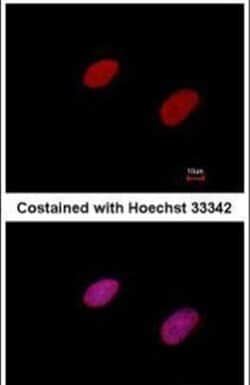
- Most of the encoded protein is located in the nucleus but some is also present in mitochondria
- This protein may play an important role in both nuclear and mitochondrial base excision repair (BER).