PKR Recombinant Rabbit Monoclonal Antibody (23H52L96), Invitrogen™
Manufacturer: Thermo Scientific
Select a Size
| Pack Size | SKU | Availability | Price |
|---|---|---|---|
| Each of 1 | PI700286-Each-of-1 | In Stock | ₹ 48,594.00 |
PI700286 - Each of 1
In Stock
Quantity
1
Base Price: ₹ 48,594.00
GST (18%): ₹ 8,746.92
Total Price: ₹ 57,340.92
Antigen
PKR
Classification
Recombinant Monoclonal
Concentration
0.5 mg/mL
Formulation
PBS with 0.09% sodium azide
Gene Accession No.
P19525
Gene Symbols
EIF2AK2
Immunogen
A recombinant protein corresponding to amino acids 54-158.
Quantity
100 μg
Primary or Secondary
Primary
Target Species
Human
Product Type
Antibody
Isotype
IgG
Applications
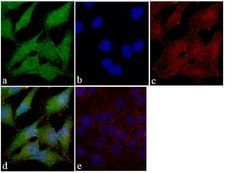
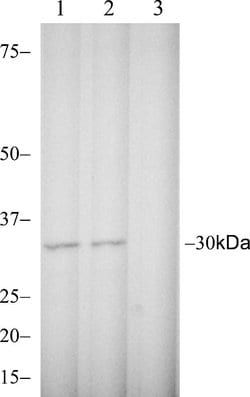
Immunocytochemistry, Western Blot
Clone
23H52L96
Conjugate
Unconjugated
Gene
EIF2AK2
Gene Alias
2310047A08Rik; 4732414G15Rik; AI467567; AI747578; double stranded RNA activated protein kinase; dsRNA-activated kinase; EC 2.7.11.1; eIF-2 alpha; eIF2a Kinase; eIF-2A protein kinase 2; EIF2AK1; EIF2AK2; eukaryotic translation initiation factor 2 alpha kinase 2; eukaryotic translation initiation factor 2-alpha kinase 2; IFN- type I-induced and dsRNA-activated kinase; IFN-induced and double-stranded RNA-activated kinase; interferon-induced, double-stranded RNA-activated protein kinase; interferon-inducible elF2alpha kinase; interferon-inducible RNA-dependent protein kinase; MGC126524; OTTHUMP00000201320; P1/eIF-2A protein kinase; p68 kinase; PKR; PPP1R83; Prkr; protein kinase R; protein kinase RNA-activated; protein kinase, interferon inducible double stranded RNA dependent; Protein kinase, interferon-inducible double stranded RNA dependent; protein phosphatase 1, regulatory subunit 83; serine/threonine-protein kinase TIK; T-cell viral integration site; Tik; Tyrosine-protein kinase EIF2AK2
Host Species
Rabbit
Purification Method
Protein A
Regulatory Status
RUO
Gene ID (Entrez)
5610
Content And Storage
Store at 4°C short term. For long term storage, store at -20°C, avoiding freeze/thaw cycles.
Form
Liquid
Related Products


Description
- This antibody is predicted to react with Rhesus monkey based on sequence homology
- Intact IgG appears on a non-reducing gel as ∽150 kDa band and upon reduction generating a ∽25 kDa light chain band and a ∽50 kDa heavy chain
- Recombinant rabbit monoclonal antibodies are produced using in vitro expression systems
- The expression systems are developed by cloning in the specific antibody DNA sequences from immunoreactive rabbits
- Then, individual clones are screened to select the best candidates for production
- The advantages of using recombinant rabbit monoclonal antibodies include: better specificity and sensitivity, lot-to-lot consistency, animal origin-free formulations, and broader immunoreactivity to diverse targets due to larger rabbit immune repertoire
- EIF2AK2 (PKR) is one of 4 kinases that specifically phosphorylate Ser51 of translation initiation factor eIF2-alpha in response to various environmental stresses
- EIF2AK2 plays a key role in antiviral defense mediated through its direct activation by double-stranded RNA produced by viral infection
- PKR plays a key role in IFN induced-innate antiviral response, virus-induced apoptosis, cell growth & differentiation
- PKR induces apoptosis by up-regulating Fas expression and mediates FADD/Caspase-8 death signaling pathway
- Upon viral infection, it functions as a dual protein, sequentially activating both cell survival & cell death pathways using kinase independent and dependent strategies
- PRKR regulates multiple pathways which include NF-kappaB activation, p53, p38, & PDGF signaling pathway
- PKR has been implicated in tumor suppression & malignancy
- To evade the antiviral effects of PKR, viruses have evolved multiple mechanisms, such as the inhibition of PKR by the non-structural protein (NS1) of the influenza virus
- More recently, PKR has been implicated in several neurodegenerative diseases including Alzheimer, Huntington, and amyotrophic lateral sclerosis.