INSR Monoclonal Antibody (CT-3), Invitrogen™
Manufacturer: Thermo Scientific
Select a Size
| Pack Size | SKU | Availability | Price |
|---|---|---|---|
| Each of 1 | PIMA513783-Each-of-1 | In Stock | ₹ 47,481.50 |
PIMA513783 - Each of 1
In Stock
Quantity
1
Base Price: ₹ 47,481.50
GST (18%): ₹ 8,546.67
Total Price: ₹ 56,028.17
Antigen
INSR
Classification
Monoclonal
Concentration
50 μg/mL
Formulation
PBS with 0.2% BSA and 0.09% sodium azide; pH 7.4
Gene Accession No.
P06213, P15208
Gene Symbols
INSR
Immunogen
Recombinant-fragment including the C-terminal 100 amino acids of human insulin receptor
Quantity
500 μL
Primary or Secondary
Primary
Target Species
Human, Mouse
Form
Liquid
Applications
Affinity Purification, ELISA, Immunocytochemistry, Immunohistochemistry (Paraffin), Western Blot
Clone
CT-3
Conjugate
Unconjugated
Gene
INSR
Gene Alias
4932439J01Rik; CD 220; CD220; CD220 antigen; CD220 beta; CD221; D630014A15Rik; HHF 5; HHF5; IGF-I receptor; INSR; Insulin receptor; insulin receptor preproprotein; Insulin receptor subunit alpha; Insulin receptor subunit beta; IR; IR 1; IR beta; IR1; IR-1; IR-A; IR-B
Host Species
Mouse
Purification Method
Protein G
Regulatory Status
RUO
Gene ID (Entrez)
16337, 3643
Content And Storage
4° C
Isotype
IgG1
Related Products




Description
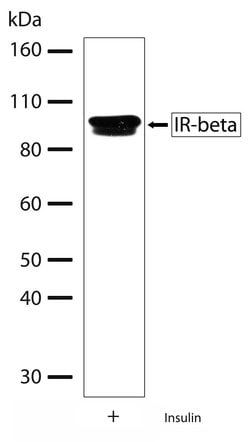
- MA5-13783 targets Insulin Receptor beta in ELISA, ICC/IF, IHC (P), Affinity Purification, and WB applications and shows reactivity with Human, mouse, Non-human primate, and Rat samples
- The MA5-13783 immunogen is recombinant-fragment including the C-terminal 100 amino acids of human insulin receptor
- INSR is a receptor tyrosine kinase
- Binding of insulin to the extracellular domain of INSR stimulates glucose uptake
- INSR and IGF-1 receptors share major structural and functional similarity
- The earliest cellular response to insulin stimulation is autophosphorylation of tyrosine in INSR
- In humans, the INSR gene is located on chromosome 19
- Defects in INSR are the cause of various insulin resistance syndromes and IGF-1R defects may also cause some forms of growth retardation.