PD-1 Monoclonal Antibody (12A7D7), Invitrogen™
Manufacturer: Thermo Scientific
Select a Size
| Pack Size | SKU | Availability | Price |
|---|---|---|---|
| Each of 1 | PIMA515781-Each-of-1 | In Stock | ₹ 50,062.50 |
PIMA515781 - Each of 1
In Stock
Quantity
1
Base Price: ₹ 50,062.50
GST (18%): ₹ 9,011.25
Total Price: ₹ 59,073.75
Antigen
PD-1
Classification
Monoclonal
Concentration
1 mg/mL
Formulation
PBS with 0.02% sodium azide
Gene Accession No.
Q02242, Q15116
Gene Symbols
Pdcd1
Immunogen
A ∽150 amino acid recombinant protein from near the amino terminus of mouse PD-1
Quantity
100 μg
Primary or Secondary
Primary
Target Species
Human, Mouse, Rat
Product Type
Antibody
Isotype
IgG1
Applications
Immunohistochemistry (Paraffin), Western Blot
Clone
12A7D7
Conjugate
Unconjugated
Gene
Pdcd1
Gene Alias
CD279; EGK_05005; hPD1; hPD-1; hPD-l; hSLE1; Ly101; mPD-1; PD1; PD-1; Pdc1; Pdcd1; programmed cell death 1; programmed cell death 1 protein; programmed cell death protein 1; programmed cell death protein 1-like; programmed death 1; Protein PD1; protein PD-1; sCD279; SLEB2; soluble CD279; systemic lupus erythematosus susceptibility 2
Host Species
Mouse
Purification Method
Protein A
Regulatory Status
RUO
Gene ID (Entrez)
18566, 301626, 5133
Content And Storage
4°, C
Form
Liquid
Related Products

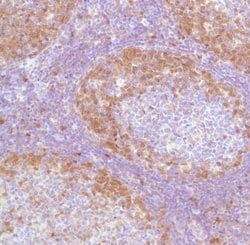
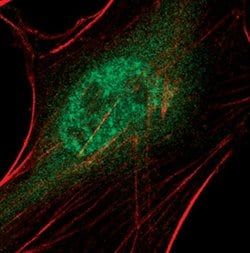
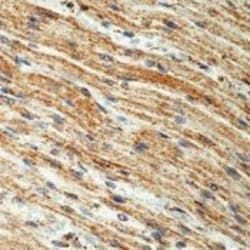
Description
- A suggested positive control is PD-1 recombinant protein
- Cell-mediated immune responses are initiated by T lymphocytes that are themselves stimulated by cognate peptides bound to MHC molecules on antig en-presenting cells (APC)
- T-cell activation is generally self-limited as activated T cells express receptors such as PD-1 (also known as PDCD-1) that mediate inhibitory signals from the APC
- PD-1 can bind two different but related ligands, PDL-1 and PDL-2
- Upon binding to either of these ligands, signals generated by PD-1 inhibit the activation of the immune response in the absence of "edanger signals"e such as LPS or other molecules associated with bacteria or other pathogens
- Evidence for this is seen in PD1-null mice who exhibit hyperactivated immune systems and autoimmune diseases
- Despite its predicted molecular weight, PD-1 often migrates at higher molecular weight in SDS-PAGE.