Progesterone Receptor Monoclonal Antibody (SP42), Invitrogen™
Manufacturer: Thermo Scientific
Select a Size
| Pack Size | SKU | Availability | Price |
|---|---|---|---|
| Each of 1 | PIMA516394-Each-of-1 | In Stock | ₹ 81,257.00 |
PIMA516394 - Each of 1
In Stock
Quantity
1
Base Price: ₹ 81,257.00
GST (18%): ₹ 14,626.26
Total Price: ₹ 95,883.26
Antigen
Progesterone Receptor
Classification
Monoclonal
Conjugate
Unconjugated
Gene
PGR
Gene Alias
9930019P03Rik; BB114106; ENSMUSG00000074510; LOW QUALITY PROTEIN: progesterone receptor; NR3C3; Nuclear receptor subfamily 3 group C member 3; p4 receptor; PGR; pot. alt. progesterone receptor; putative; PR; PR-A; PR-B; Progesterone receptor; progesterone receptor A; progesterone-receptor; putative form B; steroid hormone receptor; testicular progesterone receptor; unnamed protein product
Host Species
Rabbit
Purification Method
Protein A/G
Regulatory Status
RUO
Gene ID (Entrez)
5241
Content And Storage
-20° C, Avoid Freeze/Thaw Cycles
Form
Liquid
Applications
Flow Cytometry, Immunocytochemistry, Immunohistochemistry (Paraffin), Western Blot
Clone
SP42
Formulation
PBS with 1% BSA and 0.1% sodium azide; pH 7.6
Gene Accession No.
P06401
Gene Symbols
PGR
Immunogen
Recombinant protein encoding human progesterone receptor 412-526 aa
Quantity
500 μL
Primary or Secondary
Primary
Target Species
Human
Product Type
Antibody
Isotype
IgG
Related Products
Description
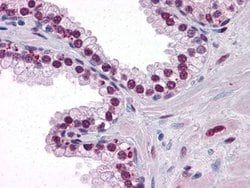
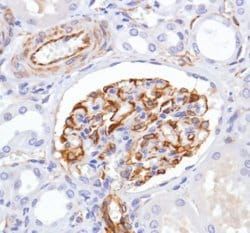
- Heat-mediated antigen retrieval is recommended prior to staining, using a 10mM citrate buffer, pH 6.0, for 10 minutes followed by cooling at room temperature for 20 min
- Following antigen retrieval, incubate samples with primary antibody for 30 min at room temperature
- A suggested positive control is breast carcinoma
- The progesterone receptor (PR) is a member of the steroid family of nuclear receptors
- The PR mediates the physiological effects of progesterone, which plays a central role in reproductive events associated with the establishment and maintenance of pregnancy
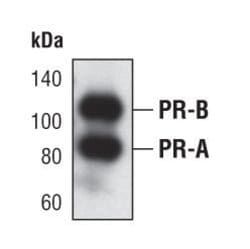
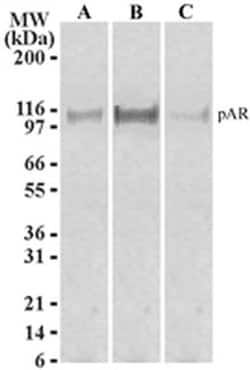
- PR is found as a 94 kDa protein (Form A) or a 120 kDa protein (Form B) due to the use of alternative translation initiation sites
- PR-B is the transcriptionally active form and is responsible for activating genes for the maintenance of the endometrium, maintenance of pregnancy, and inhibition of ovulation
- PR-A is identical to PR-B except for a 165 amino acid deletion at the N-terminus
- This deletion exposes a 140 amino acid inhibitory domain (ID) that acts as a repressor of steroid hormone transcriptional activity
- In its inactive state, PgR forms a multiprotein complex which includes heat shock proteins and immunophins
- Upon binding of progesterone hormone to its receptor, there is a conformational change that allows dimerization and binding of the receptor to progesterone response elements (PRE) sequences, resulting in activated transcription
- A Null mutation in the PGR gene leads to pleiotrophic reproductive abnormalities.