Synaptophysin Monoclonal Antibody (SP11), Invitrogen™
Manufacturer: Thermo Scientific
Select a Size
| Pack Size | SKU | Availability | Price |
|---|---|---|---|
| Each of 1 | PIMA516402-Each-of-1 | In Stock | ₹ 47,837.50 |
PIMA516402 - Each of 1
In Stock
Quantity
1
Base Price: ₹ 47,837.50
GST (18%): ₹ 8,610.75
Total Price: ₹ 56,448.25
Antigen
Synaptophysin
Classification
Monoclonal
Concentration
Conc. Not Determined
Formulation
tissue culture supernatant diluted in TBS with 1% BSA and 0.1% sodium azide; pH 7.5
Gene Accession No.
P07825, P08247, Q62277
Gene Symbols
Syp
Immunogen
Synthetic peptide corresponding to C-terminus of human synaptophysin.
Regulatory Status
RUO
Gene ID (Entrez)
20977, 24804, 6855
Content And Storage
-20°C or -80°C if preferred
Form
Liquid
Applications
Immunocytochemistry, Immunohistochemistry (Frozen), Immunohistochemistry (Paraffin), Western Blot
Clone
SP11
Conjugate
Unconjugated
Gene
Syp
Gene Alias
A230093K24Rik; AI848995; BM89 antigen; I79_012252; Major synaptic vesicle protein p38; MRX96; MRXSYP; p38; Syn; Synaptophysin; Syp; Syp I; Syp1
Host Species
Rabbit
Quantity
500 μL
Primary or Secondary
Primary
Target Species
Human, Mouse, Rat
Product Type
Antibody
Isotype
IgG
Related Products

Description
- Heat-mediated antigen retrieval is recommended prior to staining, using a 10mM citrate buffer, pH 6.0, for 10 minutes followed by cooling at room temperature for 20 min
- Following antigen retrieval, incubate samples with primary antibody for 30 min at room temperature
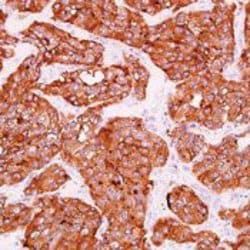
- A suggested positive control is pancreas or neuroendocrine tumor
- Synaptophysin is a calcium-binding and integral membrane glycoprotein present in presynaptic vesicles in almost all neurons
- Synaptophysin has four transmembrane domains and it forms a complex with dynamin at high calcium concentrations suggesting an involvement in synaptic vesicle endocytosis
- It is also involved in the regulation of short-term and long-term synaptic plasticity
- Synaptophysin is currently the most widely used marker for nerve terminals and for differentiating neuroendocrine tumors
- Mutations in the gene can result in mental retardation, X-linked 96.