HMGB1 Recombinant Rabbit Monoclonal Antibody (SA39-03), Invitrogen™
Manufacturer: Thermo Scientific
Select a Size
| Pack Size | SKU | Availability | Price |
|---|---|---|---|
| Each of 1 | PIMA531967-Each-of-1 | In Stock | ₹ 51,753.50 |
PIMA531967 - Each of 1
In Stock
Quantity
1
Base Price: ₹ 51,753.50
GST (18%): ₹ 9,315.63
Total Price: ₹ 61,069.13
Antigen
HMGB1
Classification
Monoclonal
Concentration
1 mg/mL
Formulation
TBS with 0.05% BSA, 40% Glycerol and 0.05% sodium azide, pH 7.4
Gene Accession No.
P09429, P63158, P63159
Gene Symbols
Hmgb1
Immunogen
Synthetic peptide within Human HMGB1 aa 151-200
Quantity
100 μL
Primary or Secondary
Primary
Target Species
Human, Mouse, Rat
Product Type
Antibody
Isotype
IgG
Applications
ChIP Assay, Flow Cytometry, Immunocytochemistry, Immunohistochemistry (Paraffin), Western Blot
Clone
SA39-03
Conjugate
Unconjugated
Gene
Hmgb1
Gene Alias
Ac2-008, amphoterin, Amphoterin antibody, DEF, DKFZp686A04236, Heparin-binding protein p30, high mobility group 1, high mobility group 1 protein, high mobility group box 1, high mobility group protein 1, High mobility group protein B1, high mobility group protein HMG1, high-mobility group (nonhistone chromosomal) protein 1, high-mobility group box 1, high-mobility-group protein, Hmg1, HMG-1, HMG3, HMG3 antibody, hmgb 1, HMGB1, hmgb-1, HMGB1 protein, hypothetical protein, non-histone protein HMG1, p30, RCJMB04_15a21, RP11-550P23.1, SBP-1, Sulfoglucuronyl carbohydrate binding protein, unnamed protein product
Host Species
Rabbit
Purification Method
Protein A
Regulatory Status
RUO
Gene ID (Entrez)
15289, 25459, 3146
Content And Storage
Store at 4°C short term. For long term storage, store at -20°C, avoiding freeze/thaw cycles.
Form
Liquid
Related Products
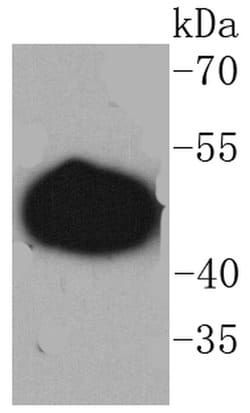
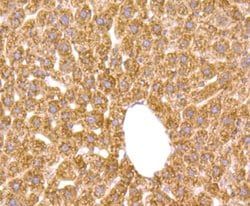
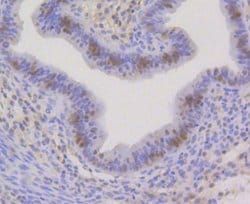
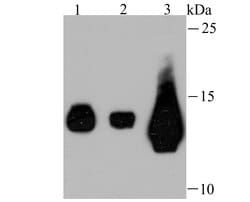
Description
- Recombinant rabbit monoclonal antibodies are produced using in vitro expression systems
- The expression systems are developed by cloning in the specific antibody DNA sequences from immunoreactive rabbits
- Then, individual clones are screened to select the best candidates for production
- The advantages of using recombinant rabbit monoclonal antibodies include: better specificity and sensitivity, lot-to-lot consistency, animal origin-free formulations, and broader immunoreactivity to diverse targets due to larger rabbit immune repertoire
- HMGB1 (High-mobility group box-1) protein was originally described as a nuclear non-histone DNA binding chromosomal protein
- However, recent studies indicate that damaged, necrotic cells liberate HMGB1 into the extracellular milieu where it functions as a proinflammatory cytokine
- Mouse HMGB1 is expressed as a 215 amino acid single chain polypeptide containing three domains: two tandem-linked positively charged DNA-binding domains (HMG box A, aa 9-79; and box B, aa 89-162), and a negatively charged 30 aa C-terminal acidic tail region
- Residues 28 - 44 and 180 - 185 contain a nuclear localization signal (NLS)
- The cytokine activity of HMGB1 is contained in the B box, while the A box is associated with the helix-loop-helix domain of transcription factors
- HMGB1 acts both as an inflammatory mediator that promotes monocyte migration and cytokine secretion, as well as a mediator of T cell-dendritic cell interaction
- HMGB1 is secreted and acts to transduce cellular signals through its high affinity receptor, RAGE and possibly, TLR2 and TLR4
- HMGB1 is highly conserved and ubiquitous in the nuclei and cytoplasm of nearly all cell types, is a necessary and sufficient mediator of inflammation during sterile and infection-associated responses
- HMGB1 also act as DNA nuclear binding protein that has recently been shown to be an early trigger of sterile inflammation in animal models of trauma-hemorrhage via the activation of the Toll-like receptor 4 (TLR4) and the receptor for the advanced glycation endproducts (RAGE)
- Moreover, HMGB1 is reported that the level of HMGB1 is elevated during sterile tissue injury, infection, lethal endotoxemia or sepsis, collagen-induced arthritis, and ischemia-reperfusion induced tissue injury.