HAPLN1 Recombinant Rabbit Monoclonal Antibody (SY02-17), Invitrogen™
Manufacturer: Thermo Scientific
Select a Size
| Pack Size | SKU | Availability | Price |
|---|---|---|---|
| Each of 1 | PIMA532100-Each-of-1 | In Stock | ₹ 47,481.50 |
PIMA532100 - Each of 1
In Stock
Quantity
1
Base Price: ₹ 47,481.50
GST (18%): ₹ 8,546.67
Total Price: ₹ 56,028.17
Antigen
HAPLN1
Classification
Monoclonal
Concentration
1 mg/mL
Formulation
TBS with 0.05% BSA, 40% Glycerol and 0.05% sodium azide, pH 7.4
Gene Accession No.
P03994, P10915, Q9QUP5
Gene Symbols
HAPLN1, hapln1a
Immunogen
Synthetic peptide withinl Human HAPLN1 aa 305-354
Quantity
100 μL
Primary or Secondary
Primary
Target Species
Human, Mouse, Rat, Zebrafish
Product Type
Antibody
Isotype
IgG
Applications
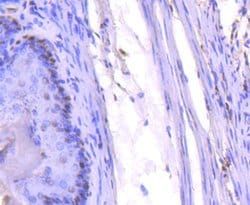
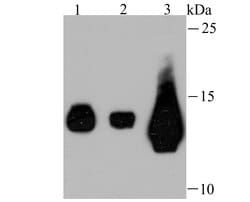
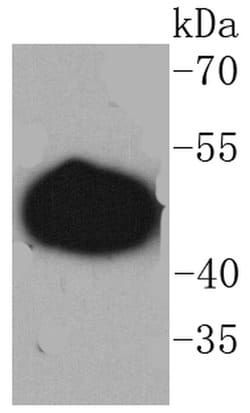
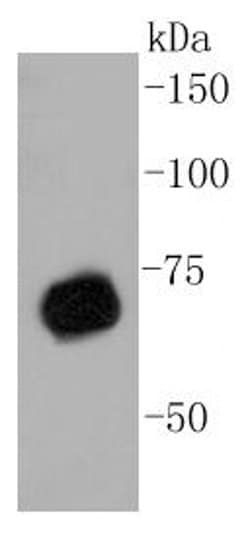
Immunocytochemistry, Immunohistochemistry, Western Blot
Clone
SY02-17
Conjugate
Unconjugated
Gene
HAPLN1
Gene Alias
BB099155, Cartilage link protein, cartilage link protein 1, cartilage linking protein 1, cartilage-link protein, Cartilage-linking protein 1, CLP, CRT1, Crtl1, Crtl1l, fc26f11, fc37g04, fc50e12, fc55h01, HAPLN1, hapln1a, Hyaluronan and proteoglycan link protein 1, hyaluronan and proteoglycan link protein 1a, hyaluronan proteoglycan link protein 1, link protein, LP, LP-1, Proteoglycan link protein, wu:fc26f11, wu:fc37g04, wu:fc50e12, wu:fc55h01
Host Species
Rabbit
Purification Method
Protein A
Regulatory Status
RUO
Gene ID (Entrez)
12950, 1404, 29331, 493635
Content And Storage
Store at 4°C short term. For long term storage, store at -20°C, avoiding freeze/thaw cycles.
Form
Liquid
Related Products
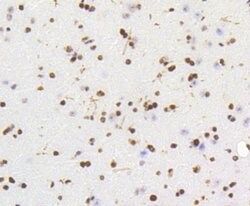
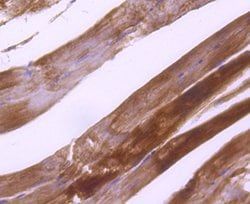
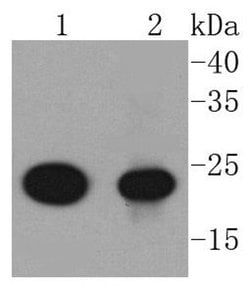
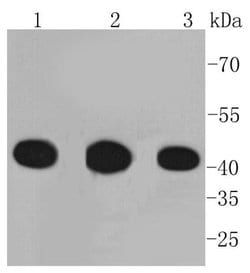
Description
- Recombinant rabbit monoclonal antibodies are produced using in vitro expression systems
- The expression systems are developed by cloning in the specific antibody DNA sequences from immunoreactive rabbits
- Then, individual clones are screened to select the best candidates for production
- The advantages of using recombinant rabbit monoclonal antibodies include: better specificity and sensitivity, lot-to-lot consistency, animal origin-free formulations, and broader immunoreactivity to diverse targets due to larger rabbit immune repertoire
- HAPLN1 belongs to the HAPLN family and contains 1 Ig like V type (immunoglobulin like) domain and 2 Link domains
- HAPLN1 stabilizes the aggregates of proteoglycan monomers with hyaluronic acid in the extracellular cartilage matrix
- Diseases associated with HAPLN1 include Cerebral Creatine Deficiency Syndrome 3 and Rheumatoid Arthritis, Systemic Juvenile.