PKC alpha Recombinant Rabbit Monoclonal Antibody (SU31-08), Invitrogen™
Manufacturer: Thermo Scientific
Select a Size
| Pack Size | SKU | Availability | Price |
|---|---|---|---|
| Each of 1 | PIMA532106-Each-of-1 | In Stock | ₹ 47,481.50 |
PIMA532106 - Each of 1
In Stock
Quantity
1
Base Price: ₹ 47,481.50
GST (18%): ₹ 8,546.67
Total Price: ₹ 56,028.17
Antigen
PKC alpha
Classification
Monoclonal
Concentration
1 mg/mL
Formulation
TBS with 0.05% BSA, 40% Glycerol and 0.05% sodium azide, pH 7.4
Gene Accession No.
P05696, P17252, P20444
Gene Symbols
PRKCA
Immunogen
Recombinant protein within Human PKC alpha aa 560-672
Quantity
100 μL
Primary or Secondary
Primary
Target Species
Human, Mouse, Rat
Product Type
Antibody
Isotype
IgG
Applications
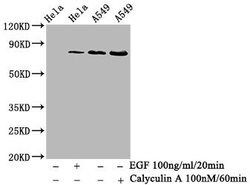
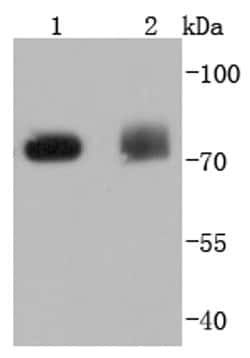
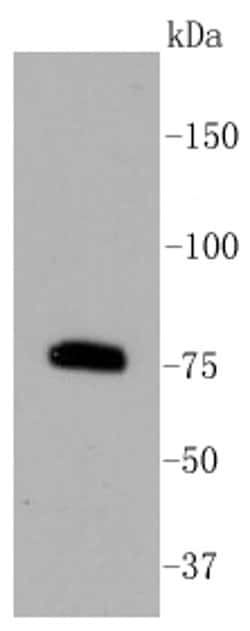
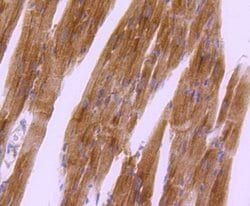
Flow Cytometry, Immunocytochemistry, Immunohistochemistry, Immunoprecipitation, Western Blot, Western Blot
Clone
SU31-08
Conjugate
Unconjugated
Gene
PRKCA
Gene Alias
AAG6, aging-associated gene 6, AI875142, EC 2.7.11.13, FHC, FTH, FTHL6, im:7139045, kinase PKC-alpha, KPCA, MGC104426, PIG15, PKC III, Pkca, PKC-A, PKC-alpha, PKC-III, PKRCA, PLIF, PRKACA, Prkca, prkcaa, protein kinase C, protein kinase C alpha, protein kinase C alpha type, protein kinase C alpha type, protein kinase C, alpha, a, protein kinase C, alpha, protein kinase C, alpha, a, protein kinase c-alpha, si:dkey-8l19.1, Unknown (protein for IMAGE:7139045), unnamed protein product
Host Species
Rabbit
Purification Method
Protein A
Regulatory Status
RUO
Gene ID (Entrez)
18750, 24680, 5578
Content And Storage
Store at 4°C short term. For long term storage, store at -20°C, avoiding freeze/thaw cycles.
Form
Liquid
Related Products
Description
- Recombinant rabbit monoclonal antibodies are produced using in vitro expression systems
- The expression systems are developed by cloning in the specific antibody DNA sequences from immunoreactive rabbits
- Then, individual clones are screened to select the best candidates for production
- The advantages of using recombinant rabbit monoclonal antibodies include: better specificity and sensitivity, lot-to-lot consistency, animal origin-free formulations, and broader immunoreactivity to diverse targets due to larger rabbit immune repertoire
- The PKC family of serine/threonine kinases, including PRKCA (PKC alpha), is activated intracellularly by signal transduction pathways
- In humans, at least 12 different PKC polypeptides have been identified
- These isoforms differ in primary structure, tissue distribution, subcellular localization, mode of action in vitro, response to extracellular signals, and substrate specificity
- PKC alpha, beta I, beta II, and gamma form the conventional family; their activities are Ca2+- and phospholipid-dependent
- Protein kinase C (PKC) can be activated by calcium and the second messenger diacylglycerol
- PKC family members phosphorylate a wide variety of protein targets and are known to be involved in diverse cellular signaling pathways
- PKC family members also serve as major receptors for phorbol esters, a class of tumor promoters
- Each member of the PKC family has a specific expression profile and is believed to play a distinct role in cells
- The protein encoded by this gene is one of the PKC family members
- This kinase has been reported to play roles in many different cellular processes, such as cell adhesion, cell transformation, cell cycle checkpoint, and cell volume control
- Knockout studies in mice suggest that this kinase may be a fundamental regulator of cardiac contractility and Ca(2+) handling in myocytes.