EphB4 Polyclonal Antibody, Invitrogen™
Manufacturer: Thermo Scientific
Select a Size
| Pack Size | SKU | Availability | Price |
|---|---|---|---|
| Each of 1 | PIPA120179-Each-of-1 | In Stock | ₹ 46,502.50 |
PIPA120179 - Each of 1
In Stock
Quantity
1
Base Price: ₹ 46,502.50
GST (18%): ₹ 8,370.45
Total Price: ₹ 54,872.95
Antigen
EphB4
Classification
Polyclonal
Conjugate
Unconjugated
Gene
EPHB4
Gene Alias
AI042935; Developmental kinase 2; EPH receptor B4; Ephb4; ephrin receptor EphB4; ephrin type-B receptor 4; Hepatoma transmembrane kinase; HTK; Mdk2; mDK-2; MYK1; soluble EPHB4 variant 1; soluble EPHB4 variant 2; soluble EPHB4 variant 3; TYRO11; Tyrosine kinase MYK-1; tyrosine-protein kinase receptor HTK; tyrosine-protein kinase TYRO11
Host Species
Goat
Purification Method
Antigen affinity chromatography
Regulatory Status
RUO
Gene ID (Entrez)
13846
Content And Storage
Store at 4°C short term. For long term storage, store at -20°C, avoiding freeze/thaw cycles.
Form
Liquid
Applications
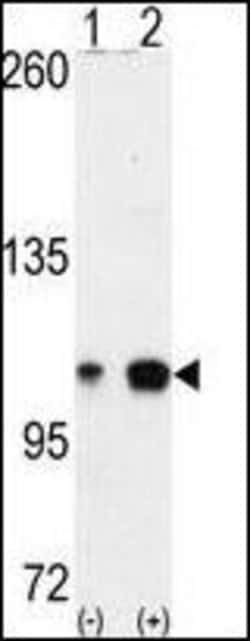
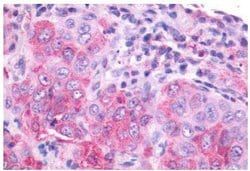
Dot Blot, ELISA, Flow Cytometry, Immunohistochemistry, Inhibition Assays, Western Blot
Concentration
0.1 mg/mL
Formulation
PBS with 5% trehalose and no preservative
Gene Accession No.
P54761
Gene Symbols
EPHB4
Immunogen
Purified, recombinant, mouse EphB4 extracellular domain, expressed in mouse NSO cells.
Quantity
25 μg
Primary or Secondary
Primary
Target Species
Mouse
Product Type
Antibody
Isotype
IgG
Related Products

Description
- Store product as a concentrated solution
- Centrifuge briefly prior to opening the vial
- EPHB4 is a receptor tyrosine kinase that belongs to the ephrin receptor family
- Members of the Eph family of kinases play important roles in diverse biological processes including nervous system development, angiogenesis and neural synapsis formation and maturation
- Based on their structures and sequence relationships, ephrins are divided into the ephrin-A (EFNA) class, which are anchored to the membrane by a glycosylphosphatidylinositol linkage, and the ephrin-B (EFNB) class, which are transmembrane proteins
- The Eph family of receptors are divided into 2 groups based on the similarity of their extracellular domain sequences and their affinities for binding ephrin-A and ephrin-B ligands
- Ephrin receptors make up the largest subgroup of the receptor tyrosine kinase (RTK) family
- The protein encoded by EphB4 binds to ephrin-B2 and plays an essential role in vascular development.