Phospho-beta Catenin/gamma Catenin (Tyr489, Tyr480) Polyclonal Antibody, Invitrogen™
Manufacturer: Thermo Scientific
Select a Size
| Pack Size | SKU | Availability | Price |
|---|---|---|---|
| Each of 1 | PIPA5143666-Each-of-1 | In Stock | ₹ 45,879.50 |
PIPA5143666 - Each of 1
In Stock
Quantity
1
Base Price: ₹ 45,879.50
GST (18%): ₹ 8,258.31
Total Price: ₹ 54,137.81
Antigen
Phospho-beta Catenin/gamma Catenin (Tyr489, Tyr480)
Classification
Polyclonal
Conjugate
Unconjugated
Gene
CTNNB1
Gene Alias
Catenin beta1; CTNNB1
Host Species
Rabbit
Purification Method
Antigen affinity chromatography
Regulatory Status
RUO
Gene ID (Entrez)
12387, 1499, 84353
Content And Storage
-20° C, Avoid Freeze/Thaw Cycles
Isotype
IgG
Applications
Immunocytochemistry, Western Blot
Concentration
Lot-Specific
Formulation
PBS with 1mg/mL BSA, 50% glycerol and 0.05% sodium azide
Gene Accession No.
P35222, Q02248, Q9WU82
Gene Symbols
CTNNB1
Immunogen
Phospho-beta-Catenin (Tyr-489) synthetic peptide corresponds to amino acid residues around tyrosine 489 of human beta-Catenin. This peptide sequence is highly conserved in rat and mouse beta-Catenin, and has high homology to the conserved site in gamma-Catenin (Tyr-480).
Quantity
100 μL
Primary or Secondary
Primary
Target Species
Human, Mouse, Rat
Form
Liquid
Related Products
Description
- This antibody was cross-adsorbed to phospho-beta-Catenin (Tyr-654) peptide before affinity purification using phospho-beta-Catenin (Tyr-489) peptide (without carrier)
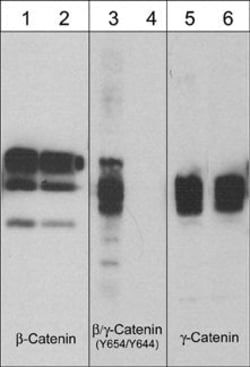
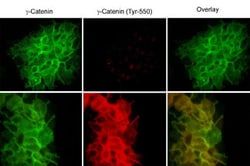
- The antibody detects 84 and 88kDa* proteins corresponding to the molecular mass of gamma-Catenin and beta-Catenin, respectively, on SDS-PAGE immunoblots of A431 cells treated with pervanadate, but does not detect these proteins in control cells
- beta-Catenin is a 92 kDa protein that binds to the cytoplasmic tail of E-Cadherin
- The cadherins, transmembrane adhesion molecules, are found with catenins at adherens junctions
- Deletions in the cytoplasmic domain of E-Cadherin eliminate catenin binding and result in a loss of cell adhesion
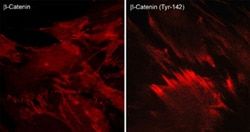
- Tyrosine phosphorylation of beta-Catenin can regulate its interaction with critical components of adherens junctions
- Both Fer and Fyn kinases phosphorylate tyrosine 142 in vitro
- Overexpression of these kinases in epithelial cells disrupts interactions between alpha- and beta-Catenins
- The phosphorylation of tyrosine 142 may act as a switch from the transcriptional to the adhesive role of beta-Catenin
- Src family kinases can also phosphorylate tyrosine 86 and 654 in beta-Catenin
- The Tyr-654 phosphorylation regulates beta-Catenin binding to E-cadherin
- Thus, site-specific tyrosine phosphorylation of beta-Catenin may regulate protein-protein interactions leading to changes in cell adhesion.