PIPA532303
CD105 Polyclonal Antibody, Invitrogen™
Manufacturer: Thermo Scientific
Select a Size
| Pack Size | SKU | Availability | Price |
|---|---|---|---|
| Each of 1 | PIPA532303-Each-of-1 | In Stock | ₹ 38,715.00 |
PIPA532303 - Each of 1
In Stock
Quantity
1
Base Price: ₹ 38,715.00
GST (18%): ₹ 6,968.70
Total Price: ₹ 45,683.70
Antigen
CD105
Classification
Polyclonal
Gene
ENG
Gene Alias
CD105, END, HHT1, ORW, ORW1, CD105 antigen, ENG
Host Species
Rabbit
Purification Method
Antigen affinity chromatography
Regulatory Status
RUO
Gene ID (Entrez)
2022
Content And Storage
Store at 4°C short term. For long term storage, store at -20°C, avoiding freeze/thaw cycles.
Form
Liquid
Applications
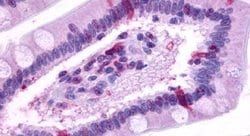
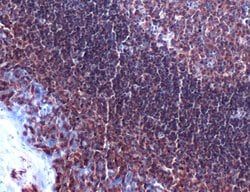
Immunohistochemistry (Paraffin)
Conjugate
Unconjugated
Gene Accession No.
P17813
Gene Symbols
ENG
Immunogen
Recombit protein encoding 26-176 aa of human CD105.
Quantity
500 μL
Primary or Secondary
Primary
Target Species
Human
Product Type
Antibody
Isotype
IgG
Related Products


Description
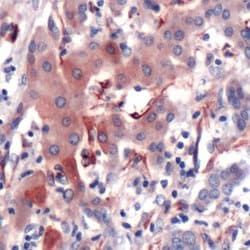
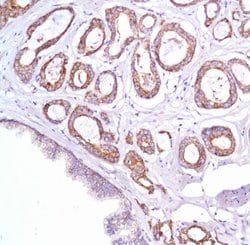
- Heat-mediated antigen retrieval is recommended prior to staining, using a 10mM citrate buffer, pH 6.0, for 10 minutes followed by cooling at room temperature for 20 min
- Following antigen retrieval, incubate samples with primary antibody for 30 min at room temperature
- A suggested positive control is tonsil tissue
- CD105 or endoglin or GP160 is a Type I transmembrane protein, which is highly expressed on human vascular endothelial cells
- It exists as an O- and N-glycosylated homodimer
- Up-regulation of endoglin expression has been demonstrated in tumor vasculature and proliferating cells, suggesting that it is a proliferation-associated endothelial cell marker
- CD105 binds to TGF-Beta1 and Beta3 with high affinity but not TGF-Beta2.