PIPA532801
GPR149 Polyclonal Antibody, Invitrogen™
Manufacturer: Thermo Scientific
Select a Size
| Pack Size | SKU | Availability | Price |
|---|---|---|---|
| Each of 1 | PIPA532801-Each-of-1 | In Stock | ₹ 46,591.50 |
PIPA532801 - Each of 1
In Stock
Quantity
1
Base Price: ₹ 46,591.50
GST (18%): ₹ 8,386.47
Total Price: ₹ 54,977.97
Antigen
GPR149
Classification
Polyclonal
Conjugate
Unconjugated
Gene
GPR149
Gene Alias
G protein-coupled receptor 149; G protein-coupled receptor PGR10; GPR149; G-protein coupled receptor PGR10; IEDA; PGR10; Probable G-protein coupled receptor 149
Host Species
Rabbit
Purification Method
Antigen affinity chromatography
Regulatory Status
RUO
Gene ID (Entrez)
344758
Content And Storage
Store at 4°C short term. For long term storage, store at -20°C, avoiding freeze/thaw cycles.
Form
Liquid
Applications
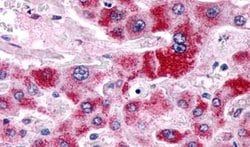
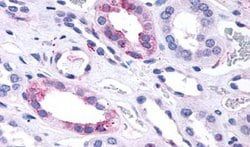
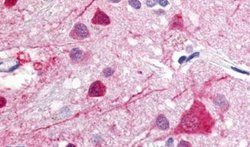
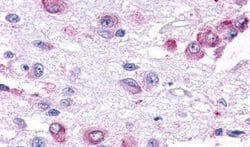
ELISA, Immunohistochemistry (Paraffin)
Concentration
1 mg/mL
Formulation
PBS with 0.1% sodium azide
Gene Accession No.
Q86SP6
Gene Symbols
GPR149
Immunogen
Synthetic 16 amino acid peptide from 3rd cytoplasmic domain of human GPR149.
Quantity
50 μg
Primary or Secondary
Primary
Target Species
Human
Product Type
Antibody
Isotype
IgG
Related Products
Description
- Percent identity with other species by BLAST analysis: Human, Gorilla, Gibbon (100%); Elephant (94%); Monkey, Marmoset (88%); Bat (81%)
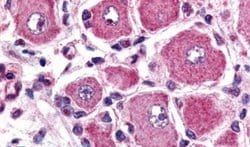
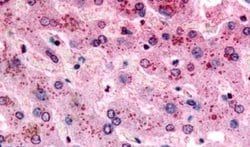
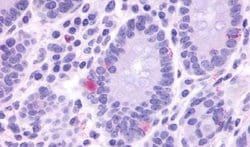
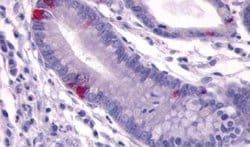
- For IHC(P), use heat induced antigen retrieval in pH 6.0 citrate buffer
- After incubation with the primary antibody, slides were incubated with biotinylated secondary antibody, followed by alkaline phosphatase-streptavidin and chromogen
- This gene encodes a seven-transmembrane G protein coupled receptor (GPCR) class A family member
- Although categorized as a class A GPCR, the encoded protein lacks the first two charged amino acids of the highly conserved Asp-Arg-Tyr (DRY) motif found in the third transmembrane helix of class A receptors which is important for efficient G protein-coupled signal transduction
- Mice with a knockout of the orthologous gene are viable and have normal maturation of the ovarian follicle, but show enhanced fertility and ovulation
- All GPCRs have a common structural architecture consisting of seven transmembrane alpha-helices interconnected by three extracellular and three intracellular loops
- A general feature of GPCR signaling is agonist-induced conformational changes in the receptor, leading to activation of the heterotrimeric G proteins, which consist of the guanine nucleotide-binding G-alpha subunit and the dimeric G-beta-gamma subunits
- The activated G proteins then bind to and activate numerous downstream effector proteins, which generate second messengers that mediate a broad range of cellular and physiological processes.