BAI3 Polyclonal Antibody, Invitrogen™
Manufacturer: Thermo Scientific
Select a Size
| Pack Size | SKU | Availability | Price |
|---|---|---|---|
| Each of 1 | PIPA533356-Each-of-1 | In Stock | ₹ 49,439.50 |
PIPA533356 - Each of 1
In Stock
Quantity
1
Base Price: ₹ 49,439.50
GST (18%): ₹ 8,899.11
Total Price: ₹ 58,338.61
Antigen
BAI3
Classification
Polyclonal
Conjugate
Unconjugated
Gene
Adgrb3
Gene Alias
A830096D10Rik; ADGRB3; Adhesion G protein-coupled receptor B3; BAI3; Brain-specific angiogenesis inhibitor 3; dJ91B17.1 (brain-specific angiogenesis inhibitor 3); G protein-coupled receptor BAI3; KIAA0550
Host Species
Rabbit
Purification Method
Antigen affinity chromatography
Regulatory Status
RUO
Gene ID (Entrez)
210933, 301309, 577
Content And Storage
Store at 4°C short term. For long term storage, store at -20°C, avoiding freeze/thaw cycles.
Form
Liquid
Applications
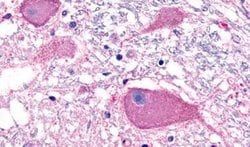
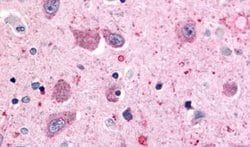
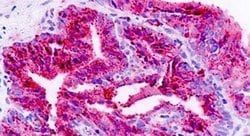
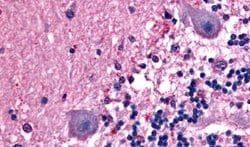
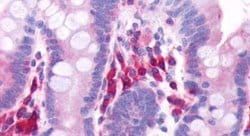
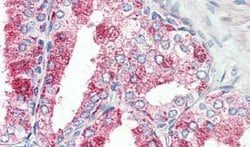
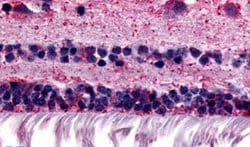
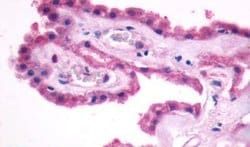
Immunohistochemistry (Paraffin)
Concentration
1 mg/mL
Formulation
PBS with 0.1% sodium azide
Gene Accession No.
O60242, Q80ZF8
Gene Symbols
Adgrb3
Immunogen
Synthetic 18 amino acid peptide from N-terminal extracellular domain of human BAI3.
Quantity
50 μg
Primary or Secondary
Primary
Target Species
Human, Mouse, Non-human Primate, Rat
Product Type
Antibody
Isotype
IgG
Related Products
Description
- Percent identity with other species by BLAST analysis: Human, Gibbon, Marmoset, Mouse, Rat, Horse (100%) Chicken (94%) Zebrafish (89%)
- This p53-target gene encodes a brain-specific angiogenesis inhibitor, a seven-span transmembrane protein, and is thought to be a member of the secretin receptor family
- Brain-specific angiogenesis proteins BAI2 and BAI3 are similar to BAI1 in structure, have similar tissue specificities, and may also play a role in angiogenesis.