LPHN3 Polyclonal Antibody, Invitrogen™
Manufacturer: Thermo Scientific
Select a Size
| Pack Size | SKU | Availability | Price |
|---|---|---|---|
| Each of 1 | PIPA533908-Each-of-1 | In Stock | ₹ 47,481.50 |
PIPA533908 - Each of 1
In Stock
Quantity
1
Base Price: ₹ 47,481.50
GST (18%): ₹ 8,546.67
Total Price: ₹ 56,028.17
Antigen
LPHN3
Classification
Polyclonal
Conjugate
Unconjugated
Gene
ADGRL3
Gene Alias
5430402I23Rik; ADGRL3; Adhesion G protein-coupled receptor L3; calcium-independent alpha-latrotoxin receptor 3; calcium-independent alpha-latrotoxin receptor homolog 3; Cirl3; CIRL-3; Cl3; D130075K09Rik; Gm1379; Kiaa0768; latrophilin 3; latrophilin homolog 3 (cow); latrophilin-3; LEC3; lectomedin 3; lectomedin-3; Lph3; LPHN3; mKIAA0768
Host Species
Rabbit
Purification Method
Antigen affinity chromatography
Regulatory Status
RUO
Gene ID (Entrez)
100056929, 100338255, 170641, 23284, 422616
Content And Storage
Store at 4°C short term. For long term storage, store at -20°C, avoiding freeze/thaw cycles.
Form
Liquid
Applications
Immunohistochemistry (Paraffin)
Concentration
1 mg/mL
Formulation
PBS with 0.1% sodium azide
Gene Accession No.
Q9HAR2, Q9Z173
Gene Symbols
ADGRL3
Immunogen
Synthetic 19 amino acid peptide from C-terminus of human LPHN3.
Quantity
50 μg
Primary or Secondary
Primary
Target Species
Chicken, Equine, Human, Non-human Primate, Rabbit, Rat
Product Type
Antibody
Isotype
IgG
Related Products
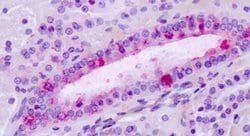
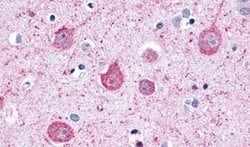
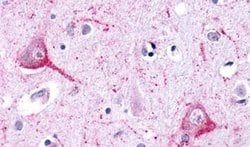
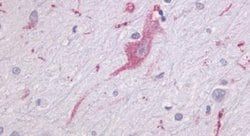
Description
- Percent identity with other species by BLAST analysis: Human, Gorilla, Monkey, Marmoset, Mouse, Rat, Bat, Elephant, Panda, Horse, Rabbit, Opossum, Turkey, Chicken, Lizard (100%)
- Plays a role in cell-cell adhesion and neuron guidance via its interactions with FLRT2 and FLRT3 that are expressed at the surface of adjacent cells
- Plays a role in the development of glutamatergic synapses in the cortex
- Important in determining the connectivity rates between the principal neurons in the cortex.