TIAL1 Polyclonal Antibody, Invitrogen™
Manufacturer: Thermo Scientific
Select a Size
| Pack Size | SKU | Availability | Price |
|---|---|---|---|
| Each of 1 | PIPA567800-Each-of-1 | In Stock | ₹ 46,502.50 |
PIPA567800 - Each of 1
In Stock
Quantity
1
Base Price: ₹ 46,502.50
GST (18%): ₹ 8,370.45
Total Price: ₹ 54,872.95
Antigen
TIAL1
Classification
Polyclonal
Conjugate
Unconjugated
Gene
TIAL1
Gene Alias
5330433G13Rik; aging-associated gene 7 protein; AL033329; mTIAR; Nucleolysin TIAR; RNA binding protein TIAR (TIA-1 related); TCBP; T-cluster binding protein; Tia1 cytotoxic granule-associated RNA binding protein-like 1; TIA-1-related nucleolysin; TIA-1-related protein; Tial 1 cytotoxic granule-associated RNA- binding protein-like 1; TIAL1; Tial1 cytotoxic granule-associated RNA binding protein-like 1; Tial1 cytotoxic granule-associated RNA-binding protein-like 1; TIAR
Host Species
Rabbit
Purification Method
affinity chromatography
Regulatory Status
RUO
Gene ID (Entrez)
21843, 361655, 7073
Content And Storage
-20°C
Form
Liquid
Applications
Western Blot
Concentration
1 mg/mL
Formulation
PBS with 50% glycerol and 0.02% sodium azide; pH 7.4
Gene Accession No.
P70318, Q01085
Gene Symbols
TIAL1
Immunogen
Synthesized peptide derived from human TIAL1.
Quantity
100 μL
Primary or Secondary
Primary
Target Species
Human, Mouse, Rat
Product Type
Antibody
Isotype
IgG
Related Products


Description
- Predicted to react with Mouse and Rat samples
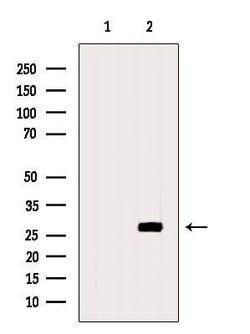
- The protein encoded by this gene is a member of a family of RNA-binding proteins, has three RNA recognition motifs (RRMs), and binds adenine and uridine-rich elements in mRNA and pre-mRNAs of a wide range of genes
- It regulates various activities including translational control, splicing and apoptosis
- Alternate transcriptional splice variants, encoding different isoforms, have been characterized
- The different isoforms have been show to function differently with respect to post-transcriptional silencing.