50-937-2
CD3 Monoclonal Antibody (HIT3a), FITC, eBioscience™, Invitrogen™
Manufacturer: Invitrogen
Select a Size
| Pack Size | SKU | Availability | Price |
|---|---|---|---|
| Each of 1 | 50-937-2-Each-of-1 | In Stock | ₹ 19,936.00 |
50-937-2 - Each of 1
In Stock
Quantity
1
Base Price: ₹ 19,936.00
GST (18%): ₹ 3,588.48
Total Price: ₹ 23,524.48
Antigen
CD3
Classification
Monoclonal
Concentration
5 μL/Test
Formulation
PBS with 0.1% gelatin, 0.2% BSA and 0.09% sodium azide; pH 7.2
Gene Accession No.
P09693, P07766, P20963, P04234
Gene Symbols
CD247, CD3D, CD3E, CD3G
Purification Method
Affinity chromatography
Regulatory Status
RUO
Gene ID (Entrez)
915, 916, 917, 919
Content And Storage
4° C, store in dark, DO NOT FREEZE!
Form
Liquid
Applications
Flow Cytometry
Clone
HIT3a
Conjugate
FITC
Gene
CD3E
Gene Alias
FLJ18683; T3E; TCRE; HCD3
Host Species
Mouse
Quantity
100 Tests
Primary or Secondary
Primary
Target Species
Human
Product Type
Antibody
Isotype
IgG2a κ
Related Products

Description
- Description: The HIT3a monoclonal antibody reacts with human CD3e, a 20 kDa subunit of the TCR complex
- Along with the other CD3 subunits gamma and delta, the ? chain is required for proper assembly, trafficking and surface expression of the TCR complex
- CD3 is expressed by thymocytes in a developmentally regulated manner and by all mature T cells
- Crosslinking of TCR with HIT3a initiates an intracellular biochemical pathway resulting in cellular activation and proliferation
- Applications Reported: The HIT3a antibody has been reported for use in flow cytometric analysis
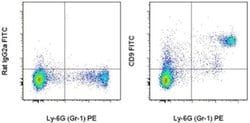
- Applications Tested: This HIT3a antibody has been pre-titrated and tested by flow cytometric analysis of normal human peripheral blood cells
- This can be used at 5 μL (1 μg) per test
- A test is defined as the amount (μg) of antibody that will stain a cell sample in a final volume of 100 μL
- Cell number should be determined empirically but can range from 10^5 to 10^8 cells/test
- Excitation: 488 nm; Emission: 520 nm; Laser: Blue Laser
- Filtration: 0.2 μm post-manufacturing filtered
- The CD3 subunit complex which is crucial in transducing antigen-recognition signals into the cytoplasm of T cells and in regulating the cell surface expression of the TCR complex
- T cell activation through the antigen receptor (TCR) involves the cytoplasmic tails of the CD3 subunits CD3 gamma, CD3 delta, CD3 epsilon and CD3 zeta
- These CD3 subunits are structurally related members of the immunoglobulins super family encoded by closely linked genes on human chromosome 11
- The CD3 components have long cytoplasmic tails that associate with cytoplasmic signal transduction molecules and this association is mediated at least in part by a double tyrosine-based motif present in a single copy in the CD3 subunits
- CD3 may play a role in TCR-induced growth arrest, cell survival and proliferation
- The CD3 antigen is present on 68-82% of normal peripheral blood lymphocytes, 65-85% of thymocytes and Purkinje cells in the cerebellum
- It is never expressed on B or NK cells
- Decreased percentages of T lymphocytes may be observed in some autoimmune diseases
- The genes encoding the CD3 epsilon, gamma and delta polypeptides are located on chromosome 11
- Defects in the CD3 gene are associated with CD3 immunodeficiency.