7144059
BHC110/LSD1 Polyclonal Antibody, Bethyl Laboratories
Rabbit Polyclonal Antibody
Manufacturer: Fischer Scientific
The price for this product is unavailable. Please request a quote
Antigen
BHC110/LSD1
Classification
Polyclonal
Form
Liquid
Regulatory Status
RUO
Formulation
TBS with 0.1% BSA and 0.09% sodium azide
Gene Alias
AOF2, LSD1
Gene Symbols
KDM1A
Isotype
IgG
Purification Method
Antigen affinity chromatography
Product Type
Antibody
Applications
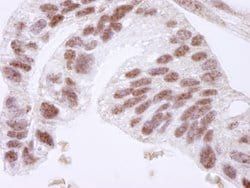
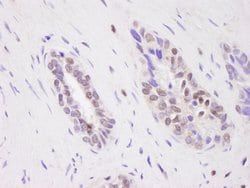
Immunohistochemistry
Conjugate
Unconjugated
Host Species
Rabbit
Target Species
Human
Gene Accession No.
O60341
Gene ID (Entrez)
23028
Immunogen
Between 50 and 100
Primary or Secondary
Primary
Content And Storage
4° C
Gene
KDM1A
Related Products
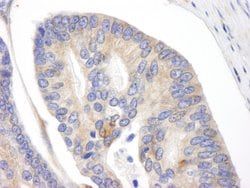
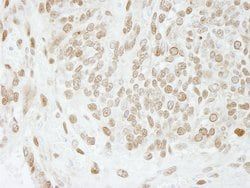


Description
- The recommended shelf life for this product is 1 year from date of receipt
- Based on 100% sequence identity, this antibody is predicted to react with Orangutan and Gorilla LSD1 is a histone demethylase that specifically demethylates 'Lys-4' of histone H3, a specific tag for epigenetic transcriptional activation, thereby acting as a corepressor
- LSD1 contains a SWIRM domain, a FAD-binding motif, and an amine oxidase domain
- This protein is a component of several histone deacetylase complexes, though it silences genes by functioning as a histone demethylase
- It acts by oxidizing the substrate by FAD to generate the corresponding imine that is subsequently hydrolyzed
- LSD1 demethylates both mono- and tri-methylted 'Lys-4' of histone H3
- This protein may play a role in the repression of neuronal genes
- Alone, it is unable to demethylate H3 'Lys-4' on nucleosomes and requires the presence of RCOR1/CoREST to achieve such activity
- It may also demethylate 'Lys-9' of histone H3, a specific tag for epigenetic transcriptional repression, thereby leading to derepression of androgen receptor target genes
- Mutations affecting this gene can result in cleft palate, psychomotor retardation, and distintive facial features.