RXRB Monoclonal Antibody (147), Invitrogen™
Manufacturer: Thermo Scientific
Select a Size
| Pack Size | SKU | Availability | Price |
|---|---|---|---|
| Each of 1 | MA14669-Each-of-1 | In Stock | ₹ 47,481.50 |
MA14669 - Each of 1
In Stock
Quantity
1
Base Price: ₹ 47,481.50
GST (18%): ₹ 8,546.67
Total Price: ₹ 56,028.17
Antigen
RXRB
Classification
Monoclonal
Conjugate
Unconjugated
Gene
Rxrb
Gene Alias
AL023085; DADB-100D22.1; DAUDI6; H-2RIIBP; MGC1831; MHC class I promoter binding protein; MHC class I regulatory element-binding protein H-2RIIBP; NR2B2; nuclear receptor coregulator 1; nuclear receptor co-regulator 1; nuclear receptor subfamily 2 group B member 2; putative retinoid X receptor beta; RCoR-1; Retinoic acid receptor RXR-beta; retinoic acid receptor, beta; retinoid X receptor; retinoid X receptor beta; retinoid X receptor, beta; Rub; RXR Beta; Rxrb; RXR-beta
Host Species
Mouse
Purification Method
Protein G
Regulatory Status
RUO
Gene ID (Entrez)
20182, 361801
Content And Storage
-20° C, Avoid Freeze/Thaw Cycles
Form
Liquid
Applications
Western Blot
Clone
147
Formulation
0.01M HEPES with 0.15M NaCl, 100μg/mL BSA, 50% glycerol and no preservative; pH 7.5
Gene Accession No.
P28704, P49743
Gene Symbols
Rxrb
Immunogen
Synthetic peptide corresponding to the hinge region of mouse RXRB conjugated to KLH
Quantity
100 μL
Primary or Secondary
Primary
Target Species
Mouse, Rat
Product Type
Antibody
Isotype
IgG1
Related Products





Description
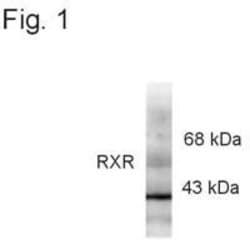
- This antibody is specific for the ∽48 kDa RXR-beta protein
- This gene encodes a member of the retinoid X receptor (RXR) family of nuclear receptors which are involved in mediating the effects of retinoic acid (RA)
- This receptor forms homodimers with the retinoic acid, thyroid hormone, and vitamin D receptors, increasing both DNA binding and transcriptional function on their respective response elements
- The gene lies within the major histocompatibility complex (MHC) class II region on chromosome 6.