MAB374AF488
MilliporeSigma™ Mouse anti-GAPDH, Clone: 6C5, Alexa Fluor 488,
Manufacturer: MilliporeSigma™
Select a Size
| Pack Size | SKU | Availability | Price |
|---|---|---|---|
| Each of 1 | MAB374AF488-Each-of-1 | In Stock | ₹ 43,318.08 |
MAB374AF488 - Each of 1
In Stock
Quantity
1
Base Price: ₹ 43,318.08
GST (18%): ₹ 7,797.254
Total Price: ₹ 51,115.334
Antigen
GAPDH
Classification
Monoclonal
Conjugate
Alexa Fluor 488
Gene Accession No.
P46406
Host Species
Mouse
Purification Method
Protein A Purfied
Regulatory Status
RUO
Primary or Secondary
Primary
Target Species
Human, Mouse
Form
Purified
Applications
Immunocytochemistry
Clone
6C5
Formulation
Purified mouse conjugate antibody in buffer containing PBS 15mg/mL BSA and 0.1% Sodium Azide.
Gene Symbols
GAPDH; GAPD
Immunogen
Glyceraldehyde-3-phosphate dehydrogenase from rabbit muscle.
Quantity
100 μL
Research Discipline
Signaling
Gene ID (Entrez)
NM_001082253.1
Content And Storage
Stable for one year at 2°C to 8°C from date of receipt.
Isotype
IgG1
Related Products




Description
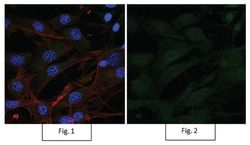
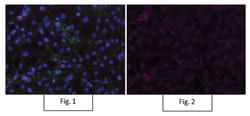
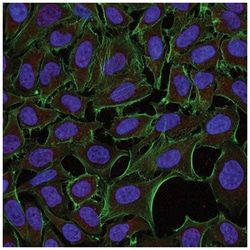
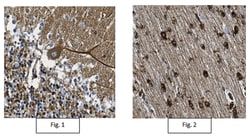
- Specifically detects GAPDH clone: 6C5 in Human, Mouse samples, and it is validated for Immunocytochemistry Glyceraldehyde 3-phosphate dehydrogenase (GAPDH) is an ubiquitous glycolytic enzyme present in reasonably high levels in almost all tissues
- The complete and functional enzyme is a tetramer with each of four identical subunits occupying the vertex of a tetrahedron
- Its binding domains also include one principally interacting with NAD + and another interacting with glyceraldehyde 3-phosphate (GAP)
- As a 'house-keeping' enzyme, it catalyzes the synthesis of 1,3-biphosphoglycerate, a 'high energy' intermediate used for the synthesis of ATP
- Besides its cytoplasmic role in metabolism, it is also involved in the initial stages of apoptosis or oxidative stress response where it is translocated to the nucleus
- Such actions may reflect the role of GAPDH in DNA repair or as one nuclear carrier for apoptotic molecules
- GAPDH can also bind specifically to proteins implicated in the pathogenesis of a variety of neurodegenerative disorders, including the beta-amyloid precursor protein and the Huntingtin protein where reduced function of GAPDH is associated with Alzheimer's and Huntington's disease fibroblasts
- GAPDH has also been identified as a potential target for nitric oxide (NO)-mediated cellular toxicity.