WRN Monoclonal Antibody (195C), Active Motif™
Mouse Monoclonal Antibody
Manufacturer: Fischer Scientific
The price for this product is unavailable. Please request a quote
Antigen
WRN
Concentration
1 mg/mL
Classification
Monoclonal
Form
Liquid
Regulatory Status
RUO
Formulation
PBS with 30% glycerol and 0.035% sodium azide; pH 7.5
Gene Alias
AI846146; DKFZp686C2056; DNA helicase, RecQ-like type 3; Exonuclease WRN; RecQ protein-like 2; RECQ3; RECQL2; RECQL3; RGD1564788; similar to Werner syndrome helicase homolog; Werner syndrome ATP-dependent helicase; Werner syndrome ATP-dependent helicase homolog; Werner syndrome homolog (human); Werner syndrome RecQ like helicase; Werner syndrome, RecQ helicase-like; Wrn
Gene Symbols
WRN
Isotype
IgG1
Purification Method
Protein G
Product Type
Antibody
Clone
195C
Applications
Immunocytochemistry, Immunofluorescence, Immunohistochemistry, Western Blot
Conjugate
Unconjugated
Host Species
Mouse
Target Species
Human
Gene Accession No.
Q14191
Gene ID (Entrez)
7486
Immunogen
This WRN antibody was raised against a recombinant protein corresponding to amino acids 1072 - 1432 of human WRN.
Primary or Secondary
Primary
Content And Storage
-20°C, Avoid Freeze/Thaw Cycles
Gene
WRN
Related Products


Description
- This gene encodes a member of the RecQ subfamily and the DEAH (Asp-Glu-Ala-His) subfamily of DNA and RNA helicases
- DNA helicases are involved in many aspects of DNA metabolism, including transcription, replication, recombination, and repair
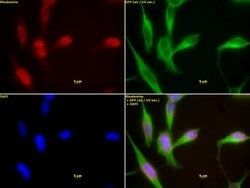
- This protein contains a nuclear localization signal in the C-terminus and shows a predominant nucleolar localization
- It possesses an intrinsic 3' to 5' DNA helicase activity, and is also a 3' to 5' exonuclease
- Based on interactions between this protein and Ku70/80 heterodimer in DNA end processing, this protein may be involved in the repair of double strand DNA breaks
- Defects in this gene are the cause of Werner syndrome, an autosomal recessive disorder characterized by premature aging.