7188783
5-Hydroxymethylcytosine (5-hmC) Polyclonal Antibody, Active Motif™
Rabbit Polyclonal Antibody
Manufacturer: Fischer Scientific
The price for this product is unavailable. Please request a quote
Antigen
5-Hydroxymethylcytosine (5-hmC)
Applications
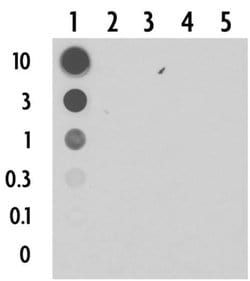
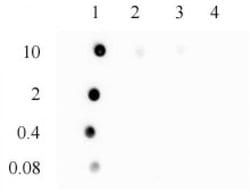
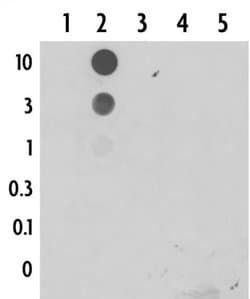
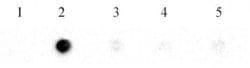
Dot Blot, Immunohistochemistry, Immunoprecipitation
Conjugate
Unconjugated
Host Species
Rabbit
Target Species
Human, Mouse
Gene Alias
5hmc; 5-hmc; 5-HydroxymethylCytidine; C5H7N3O2
Isotype
IgG
Purification Method
Protein A
Product Type
Antibody
Concentration
1 mg/mL
Classification
Polyclonal
Form
Liquid
Regulatory Status
RUO
Formulation
PBS with 30% glycerol and 0.035% sodium azide; pH 7.5
Immunogen
This 5-Hydroxymethylcytidine antibody was raised against 5-hydroxymethylcytidine conjugated to kLH and recognizes 5-hydroxymethylcytosine.
Primary or Secondary
Primary
Content And Storage
-20°C, Avoid Freeze/Thaw Cycles
Related Products



Description
- 5-hydroxymethylcytosine (5-hmC) has been recently discovered in mammalian DNA
- 5-hmC results from the enzymatic conversion of 5-methylcytosine into 5-hydroxymethylcytosine by the TET family of oxygenases
- Initially, the 5-hmC base had been identified in Purkinje neurons, in granule cells and embryonic stem cells where it is present at high levels (up to 0,6% of total nucleotides in Purkinje cells)
- A recent report indicates that 5-hmC is also abundant in brain tissue, especially in areas that are associated with higher cognitive functions.Early evidence suggests that 5-hmC may represent an intermediate in a new pathway which demethylates DNA, converting 5-mC to cytosine
- Although its precise role has still to be shown, recent results indicate, however, that 5-hmC may play important roles distinct from 5-mC
- This may open up entirely new perspectives in epigenetic studies.