MilliporeSigma™ phospho Smad1/Smad5/Smad8 (Ser463/465), Rabbit, Unlabeled, Polyclonal,
Manufacturer: MilliporeSigma™
Select a Size
| Pack Size | SKU | Availability | Price |
|---|---|---|---|
| Each of 1 | AB3848IMI-Each-of-1 | In Stock | ₹ 43,318.08 |
AB3848IMI - Each of 1
In Stock
Quantity
1
Base Price: ₹ 43,318.08
GST (18%): ₹ 7,797.254
Total Price: ₹ 51,115.334
Antigen
phospho Smad1/Smad5/Smad8 (Ser463/465)
Classification
Polyclonal
Conjugate
Unconjugated
Gene
SMAD1, BSP1, MADH1, MADR1
Host Species
Rabbit
Purification Method
Affinity Purified
Regulatory Status
RUO
Primary or Secondary
Primary
Test Specificity
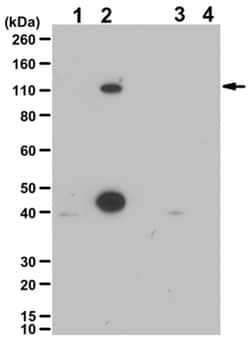
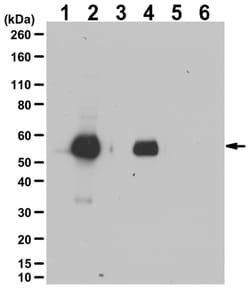
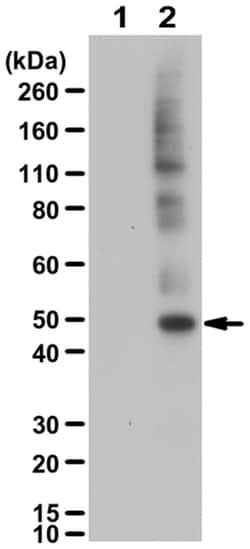
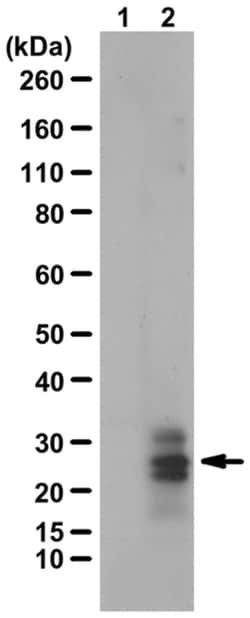
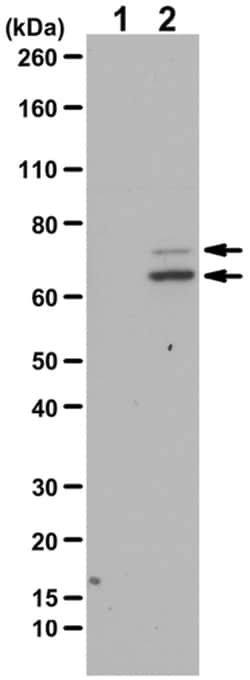
This rabbit polyclonal antibody recognizes SMAD1/5/8 phosphorylated on their last two serine residues within the C-terminal end Ser-Ser-X-Ser (SSXS) motif. Target serine residues are present in human/mouse SMAD1 (S463/S465), rat SMAD1 (S466/S468), human/mouse/rat SMAD5 (S463/S465), human SMAD9 (S465/S467), mouse SMAD9 (S428/S430), and rat SMAD9 (S432/S434), but absent in human SMAD1 spliced isoform 2. SMAD9 is also known as SMAD8. Target bands detection was blocked by the immunogen phosphopeptide, but not by the corresponding non-phosphopeptide.
Content And Storage
Stable for 1 year at 2°-8°C from date of receipt.
Applications
Western Blot
Concentration
Please refer to lot specific datasheet.
Formulation
Purified rabbit polyclonal antibdoy in buffer containing 0.1M Tris-Glycine (pH 7.4) 150mM NaCl with 0.05% Sodium Azide.
Gene Accession No.
Q15797
Immunogen
KLH-conjugated linear peptide corresponding to human SMAD1 C-terminal end sequence phosphorylated on the last two serine residues (S463/S465).
Quantity
100 μL
Research Discipline
Epigenetics & Nuclear Function
Gene ID (Entrez)
NP_005891
Target Species
Human
Related Products
Description
- Mothers against decapentaplegic homolog 1 (UniProt Q15797; also known as BSP-1, hSMAD1, JV4-1, MAD homolog 1, Mothers against DPP homolog 1, Mad-related protein 1, SMAD 1, SMAD family member 1, Smad1, Transforming growth factor-beta-signaling protein 1) is encoded by the SMAD1 (also known as BSP1, MADH1, MADR1) gene (Gene ID 4086) in human
- Mammalian SMADs constitute a family of transcription factors that are subdivided into three groups
- SMAD1, 2, 3, 5, and 9 (a.k.a
- SMAD8) are receptor-regulated SMADs or R-SMADs
- SMAD4 is the only known mammalian common mediator SMAD or Co-SMAD and it mediates both the TGF- and BMP signalling pathways
- SMAD6 and SMAD7 are inhibitory SMADs or I-SMADs that block the activation of R-SMADs by Co-SMAD via competitive binding
- SMADs share a similar structure feature consisting of the conserved N-terminal Mad-homology 1 (MH1; a.a
- 12-136 of hSMAD1, a.a
- 13-137 of hSMAD2, a.a
- 16-140 of hSMAD8) and C-terminal MH2 (a.a
- 271-465 of hSMAD1 and hSMAD2, a.a
- 273-467 of hSMAD8) domains joined by a non-conserved linker region among SMADs
- MH1 domain in R-SMADs and Co-SMADs contains N-terminus nuclear localization signals (NLS), while SMAD4 has nuclear export signals (NES) in this domain
- The MH2 domain is responsible for gene transactivation as well as for mediating SMAD-receptor, SMAD-SMAD, SMAD-coactivators and SMAD-corepressors interactions
- A TGF- ligand (TGF- for SMAD2/3 and BMP for SMAD1/5/8) initiates signalling by binding and engaging type I and type II receptor serine/threonine kinases on the cell surface, allowing T RII-dependent phosphorylation of T RI kinase domain, which then instigates signalling by phosphorylating the last two serine residues within the conserved C-terminal end Ser-Ser-X-Ser (SSXS) motif of SMAD proteins.